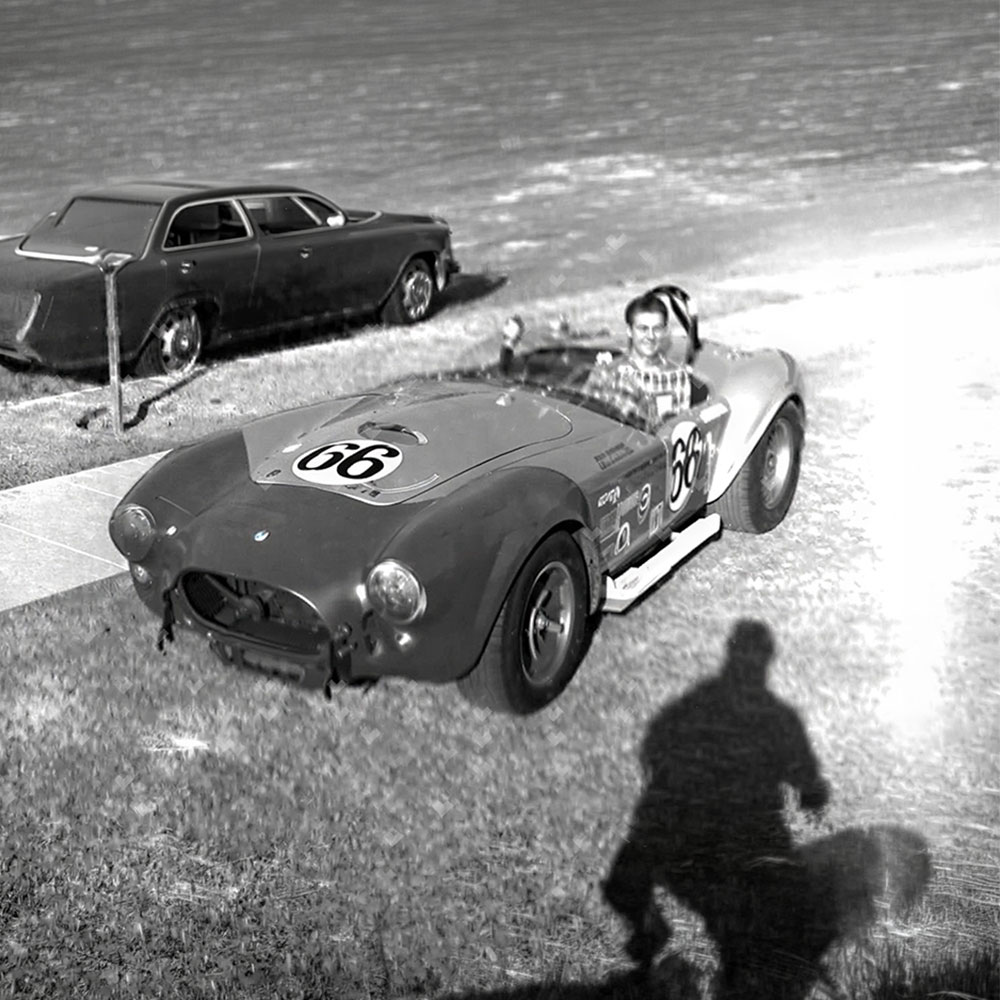
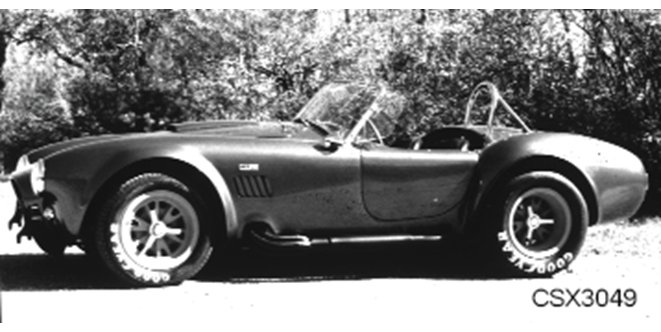
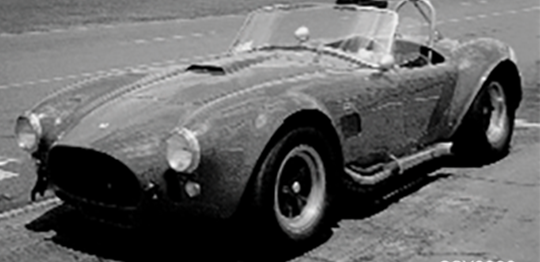
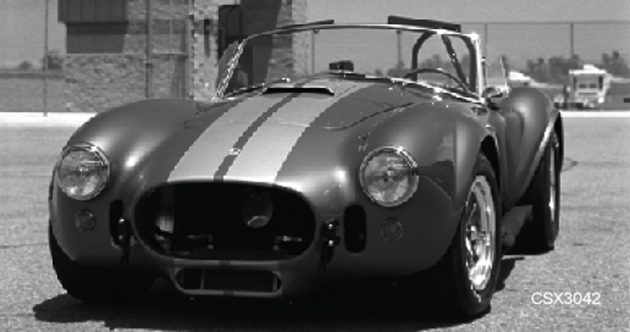
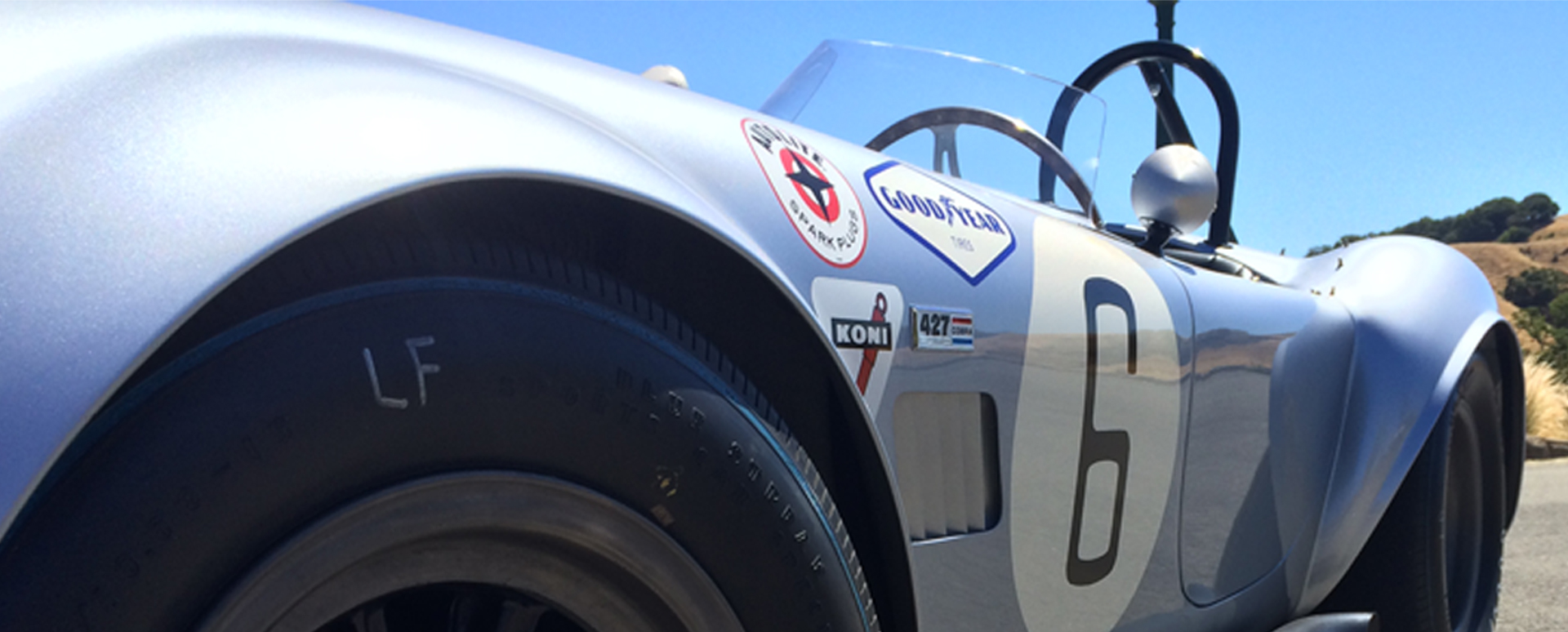
CSX3035 was built as a silver S/C and went to Hi-Performance Motors for their inventory. In May of 1966
George Harm and Dick Smith of Fresno, California were shopping for a race car and went to Mel Burns Ford
in
Long Beach. They didn’t have one on hand but they said they could get one pretty quickly. CSX3035 was
delivered to Mel Burns and the sale was completed. When they got the car back to Fresno the first thing
they
did was to paint the nose and front fenders Day-Glo Orange. Smith bought Harm out in 1967 and the nose
color
was changed to Day-Glo Yellow. He was very successful with the car and at the 1967 ARRC at Daytona he
won the
A/Production National Championship.
Enter, Shelby American’s Eastern Field Sales Representative Charles Beidler. As a field sales
representative,
Beidler’s job was to act as a liaison between the dealers in his geographical area and the factory. He
helped
dealers with orders and assisted in resolving customer problems. He approved warranty work and also
expedited
orders when necessary. If a dealer needed a car, it was sometimes faster to get it from another dealer
than
from the factory. Beidler knew where the cars were in his area and he would contact the dealer who had
the car
and arrange for it to be shipped to the dealer who needed it. Then he worked with the factory to
expedite the
replacement of the “borrowed” car with one the same color from the factory’s inventory.
On one of his trips to the factory in Los Angeles, Beidler noticed the long rows of uncompleted 427
race cars
sitting idle. He knew they weren’t selling, so he wondered out loud, “What if we had those things out on
the
street?” Shelby’s National Sales Manager, Dante Cardone, thought the idea had merit and began to pursue
it.
One of the obvious appeals of the 427 Cobra was that it was the fastest production car ever made.
Beidler
reasoned that someone who bought one because of that fact would be hard-pressed to turn their back on
the
opportunity to buy the fastest of the fast. As it turned out, he was right. He went back to his sales
territory in the northeast and immediately found a buyer for this new model – the 427 Cobra S/C.
Depending on
who you talked to, those letters stood for either “Semi/Competition” or “Street/ Competition.” The car
went to
the owner of a large trucking company and was sold through Archway Ford in Baltimore, Maryland. Beidler
recalls that he ended up selling about three-quarters of all the 427 S/Cs to dealers in the northeast.
Once
the first dozen or so 427 competition models were completed and delivered, the remaining cars were
finished
one at a time, as orders arrived. All of the cars invoiced in 1965 were full competition models but once
the
S/C was offered, the remaining cars were built either way.
The dealer cost for a 427 Cobra street car was $6195. The advertised retail price was $7495. As
production
began to wind down, as cars in the CSX33xx range were being built and given 427 engines again, the
dealer cost
rose to $6595. In late 1967, everyone at Shelby American knew things were about to change: the 427 Cobra
would
be discontinued, and production of the 1968 models was moving to Michigan. In order not to be left with
any
cars after they moved out of the airport hangars, the dealer price was cut on some cars to $5195.
Initially Shelby American charged between $9500 and $10,000 for 427 Cobra competition cars, to both
dealers
and private individuals. When the initial demand subsided, the price settled at $9500 but options almost
inevitably raised the price above $10,000 with some retail buyers paying well over $12,000 for their
cars.
By the time the S/C concept came about, it was clear to almost everyone at Shelby American that there
were
more 427 Cobra competition cars than there were buyers for them. One had only to look outside at the
long line
of unfinished cars in raw aluminum sitting on jackstands to understand that. The dealer price of the S/C
was
substantially reduced from the price of the competition car (to $7395) in order to motivate dealers.
Retail
price of an S/C was around $8500 but since these cars were so rare, there was really no set price and
dealers
could charge whatever they wanted.
In that the S/C was essentially the same car as the competition model, the difference in cost probably
led
some racers to buy an S/C instead of a competition car. There was also the question of availability.
Often
when someone made the decision to purchase a new race car, they wanted it right now. If an S/C was
sitting
there on the showroom floor, and the price was lower, they chose the S/C instead of specially ordering a
competition car and then having to wait 30 to 60 days for it. Unless they were car shopping in the
winter,
that was a big chunk of the racing season.
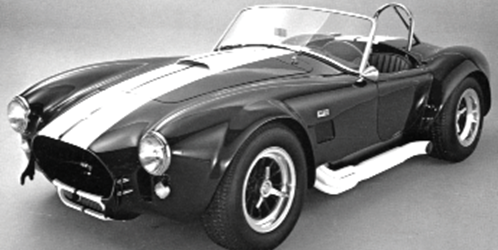
The S/C was every bit the race car the “standard” competition model was. They were both delivered with
full
windshields, soft tops with side curtains and tonneau covers. S/Cs had mufflers—or what passed for
mufflers—in
their side exhausts while the competition cars had no mufflers. A fair number of S/Cs found their way
onto the
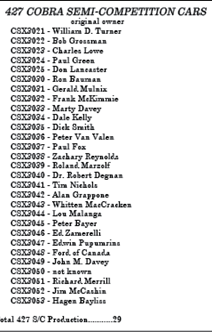
race track. Bob Grossman, an exotic sports car dealer from Nyack, NY with a lot of race experience,
purchased
CSX3022 and raced it in SCCA events in the northeast. West coast SCCA racer Jim McCashin bought CSX3052
and
raced it successfully in several events in 1968. And Dick Smith purchased CSX3035 and raced it in
SCCA National events in 1967. He drove the car to the 1967 SCCA A/Production National Championship and
was
Northern Pacific Division Champion in 1968. Smith was officially clocked at 198 mph at Daytona in the
car
(although he later learned that Ford representatives had unofficially clocked him at 201 mph). Gerald
Mulnix
bought CSX3031 and finished 8th in the SCCA’s Central Division in 1968.