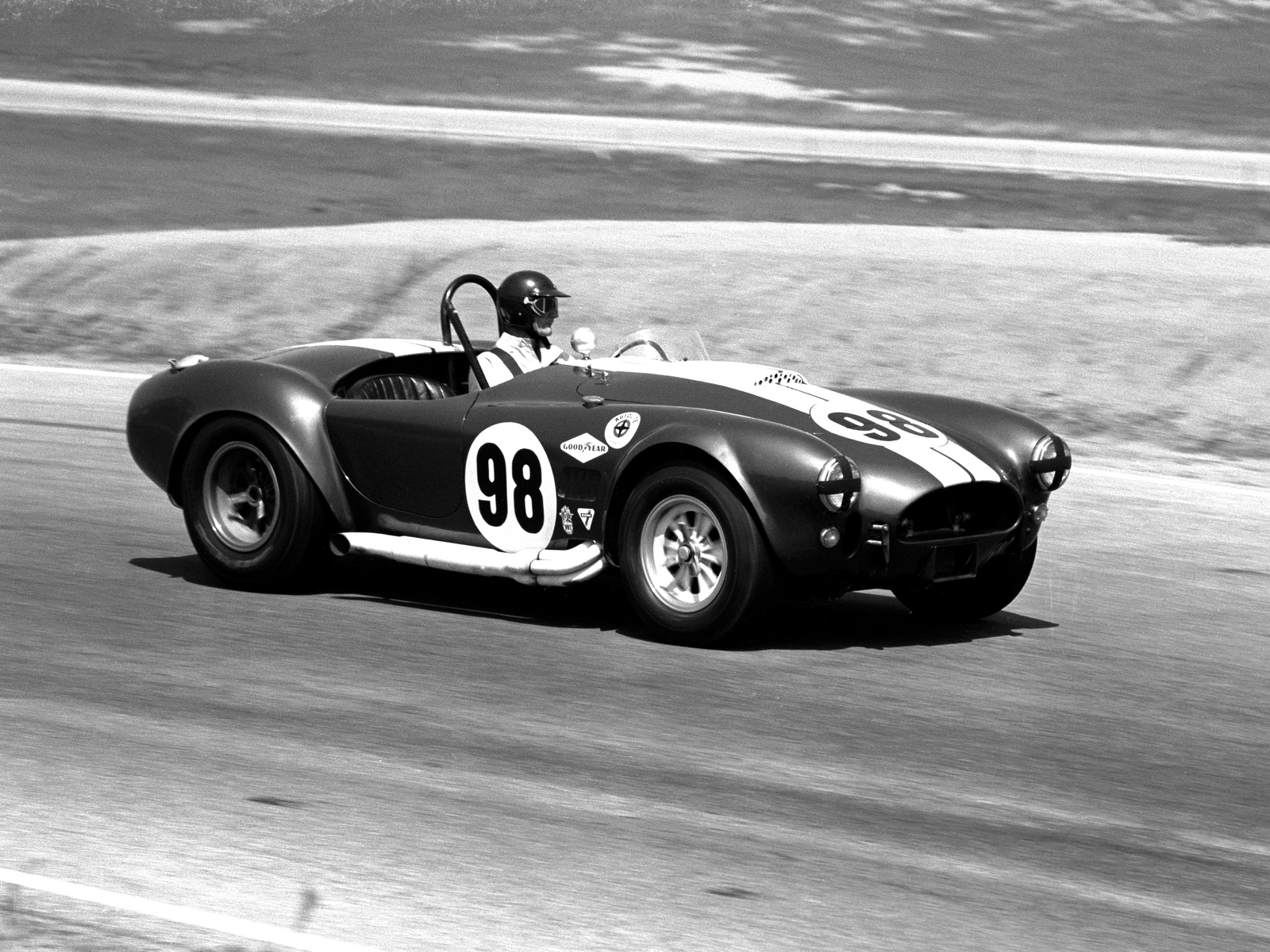
The history of racing is full of one-shot-wonders and flashes-in-the-pan. It is an unforgiving sport where everything unfolds in public and a victory today does not guarantee anything tomorrow—except another chance to lose. In the course of only three short years, the Cobras had proven themselves to be tenacious. They cut their teeth in SCCA racing in this country and after the initial problems were resolved, Cobra roadsters experienced the type of reliability rarely seen in sports car racing. They transformed Chevrolet’s dramatic, new Corvette Sting Ray into a perpetual backmarker. Then the factory team expanded its horizons, competing in the U.S. Manufac-turer’s Championship. They became the cars to beat in that series, too.
By 1964, the team of factory Cobra roadsters, supplanted by a handful of specially-bodied coupes, carried the fight to the tracks of Europe. Their goal was to dethrone the King—Ferrari—and to capture the World Manufacturer’s Championship for GT Cars. Ferrari virtually owned that title, winning it the previous twelve years in a row. In 1964 Shelby’s team, a combination of California hot-rodders, circle track fabricators and expatriate race mechanics from New Zealand and Great Britain, was about to swipe the trophy from Ferrari’s hands. And they would have, if the wily “Commendatore” had not twisted a few arms behind the closed doors of the FIA and had a race in Italy cancelled. He knew it would have almost certainly been won by the Cobras, which would have given them enough points to win the championship.
There is an adage in racing that says, “There is nothing as old as last year’s race car.” Both Ferrari and
Shelby understood this, and during the 1964 season both were developing successors to the cars they were
currently fielding. In Shelby American’s race shop, fabricators and mechanics were busy maintaining the team’s
cars which raced in the U.S. while a second team in Europe prepared the FIA cars for events over there. None of
them had time to think beyond the next race. But Shelby did; he was already thinking a year down the road. He
knew that if he didn’t come up with something —some kind of secret weapon—in the league he was playing in, the
only thing a one-year old race car was good for was watching the race’s leaders from mid-pack. And that would
only last a few laps.
Sketchy reports filtered back to Shelby that Ferrari was building a new car for the
1965 season. It was sure to be faster than the cars on his current team. Shelby didn’t have time to start with a
clean sheet of paper, so anything he came up with would, of necessity, have to be based on the current Cobra.
Would “new and improved” do it? Not likely. The Cobra 289 race engines were making about 385 horsepower but that
was the outer limit of their reliability. And as far as cutting weight, there wasn’t much you could take out of
a car that only weighed 2300 pounds to begin with.

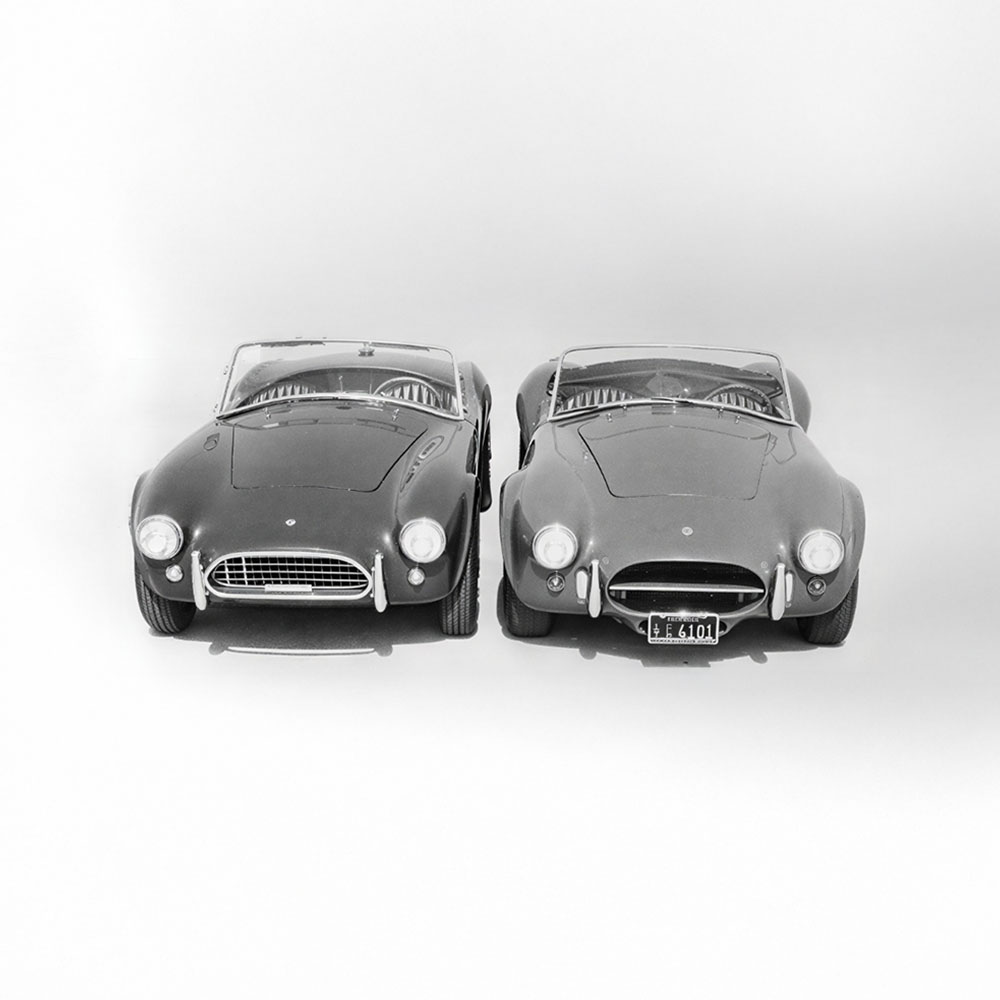
The 289 and 427 Cobras shared the same wheelbase (90˝) but even though their shares were similar, they didn’t share much else. The 427 was wider and heavier and, of course, had about 100 more horsepower. To the average person they may have looked the same but aside from sharing windshields, hoods and trunks, doors and other small trim items they were two different cars. The 289’s ride was rough and sharp while the 427’s was smooth and seemingly effortless. Anything the 289 did poorly, the 427 did well; and anything the 289 did well, the 427 did better. Shelby American public relations photo, circa 1965.
Peter Brock’s slippery coupe body was a factor in the longer European races. The coupes were only slightly heavier than the roadsters but they more than made up for it in the aerodynamics department. Their slippery shape allowed the 385 horsepower engine to push the cars through the air faster. Roadsters topped out at LeMans at around 165 mph. The coupe added 25 mph to that. As a bonus, the Coupes’ mileage was better than the roadsters, so the cars spent less time in the pits taking on fuel.
The catalyst for the second generation Cobra was Ken Miles. In the 1950s and early 1960s, sports car racing was a very small universe and everyone knew everyone else. Within a particular geographical area the sense of community was magnified. In southern California, Ken Miles was on everyone’s short list of most talented drivers. He was practically unbeatable in a Porsche Spyder but his strong suit was the “special”—a one-of-a-kind, modified car that was lightened and powered by a larger engine. This, in turn, required upgrading of the suspension and brakes and often parts of the body were massaged. Specials raced in a separate class which had a minimum of rules, most of them addressing safety features. The modifieds were the equivalent of a “run-what-you-brung class” where almost anything went. Miles’ first MG special won the first race he entered—Pebble Beach in 1953. Before long he was recognized as the finest Under-1500 cc driver on the west coast.
Miles’ MG was followed by the car that cemented his reputation, the “Flying Shingle.” It was smaller, lighter, lower and faster that its predecessor. A Porsche ride soon came his way and before long he was building another special, a Porsche-powered Cooper which got the name “Pooper.” Miles was so successful against the factory Porsches that his employer, a Porsche dealer, was ordered by the factory to get him to retire the Pooper and replace it with a factory ride.
Carroll Shelby had competed against Miles and had long recognized his talent behind the wheel. Miles was also an exceptional development driver. He had the rare ability to verbalize about a car’s performance to the engineers, fabricators and mechanics who would make the changes which enabled the car to go faster or handle better. Shelby initially hired Miles on a part-time basis to test Cobras. Before long Miles closed his own shop in Hollywood (which did sports car race preparation and mechanical work) and joined Shelby American as its Competition Director. He was also one of the Cobra team’s main drivers and in this capacity he spent a lot of time thinking about ways to make the Cobra even faster.
Instead of trying to make incremental changes and modifications to the current Cobra competition roadster, which was, itself, an evolution light years away from the first Cobra race car (CSX2002), Miles saw the existing Cobra as the starting point for a “special.” The 289 Cobra race engine’s power ceiling of 385 horsepower was too limiting. Thinking out of the box, Miles recalled that he had driven a NASCAR stock car at Riverside – a Ford Galaxie that was powered by a 427 cubic-inch engine which pumped out 485 horsepower without breathing hard. It also had stump-pulling torque without the high RPMs which work against reliability. The thought of a Cobra roadster with another hundred horsepower must have made him stroke his chin and smile.
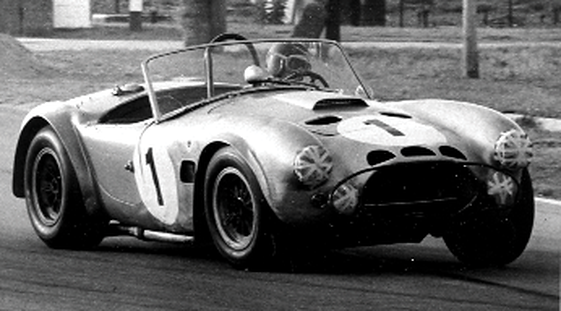
CSX2196 at Sebring; March, 1964.
While the new Cobra was being redesigned, Ken Miles was busy building another “special.” The original body was removed from CSX2196 and the subframe which supported the body was cut away. Everything else was stripped off until all that existed was a bare ladder frame. It was strengthened and a new, lightweight body was constructed using a one-piece front end which combined the nose, cowl, hood and front fenders. It was hinged at the front so it flipped forward to expose the engine, radiator and the entire front suspension.
The rear clip – the trunk, rear cowl and rear fenders – was also one piece and was hinged at the rear to flip
back, exposing the rear end, rear suspension and fuel tank. The car was still called “The Turd” by the
fabricators and mechanics in the race shop because they remained unconvinced that it was the way to go. However,
everyone remained on their best behavior in public, calling the car the “Flip-Top.”
Miles had an immediate
goal for the Flip-Top: Nassau in November. He had not forgotten how the Gran Sports had handed the Cobras their
heads the previous year. Shelby finally received one of the magical lightweight, aluminum 390 CID engines that
had originally been promised. It was topped with a set of four, huge 58mm Weber carburetors. Cooling was still a
concern and to keep the Cobra’s profile low in front the large radiator was angled back and a cut-out behind
it—similar to the Daytona Coupe’s—permitted hot air to exit before it got into the engine compartment. The
Flip-Top also had a series of nasty-looking louvers ahead of the scoop which resembled the Gran Sport’s
(probably just a coincidence...) and individual exhaust headers that poked through the sides of the fenders
terminating in large rain gutter-style collectors. A short, plexiglass windscreen finished off the car. It was
still identifiable as a Cobra, albeit an odd-looking one.
As soon as the Chevy boys saw this car they knew
they were in trouble. It tipped the scales at a mere 1600 lbs (some 500 lbs less than a 289 Cobra). And it was
blindingly fast. When the green flag dropped at Nassau, the large field—which included a couple of Gran Sport
Corvettes—shot forward in a howling pack. By the end of the first lap the first car came into view. It was Miles
in the Flip-Top, a full half-mile ahead of the second car! That, all by itself, was sufficient payback for the
previous year.
Miles continued to stretch the lead but the rough airport course worked against the lightweight Cobra. At about the halfway point in the race, the electric pump for the differential quit and it overheated, ending Miles’ charge. No matter: notice had been served. Shelby had upped the ante for 1965 and if everyone else wanted to stay in the game they would need new cars. Ferrari was rumored to be hard at work on a mid-engined design (designated the “250LM” or “LeMans”) and Chevrolet was filling the engine bay of the Corvette with a big block —first the 396 and shortly thereafter a 427. But nothing else captured the imagination like Shelby’s 427 Cobra. And it was Ken Miles, master of the “special,” who brought that idea to reality.
CSX2196 at Nassau; November, 1964.
Translating Miles’ findings using his two versions of CSX2196 as a baseline was not difficult. Klaus Arning’s suspension specifications formed the beginning. First, the 289 Cobra’s 3˝ main chassis tubes were increased to 4˝ for the new car. The antiquated leaf spring set-up was thrown away and a new, fully adjustable coil spring suspension was designed from scratch. The 427 engine necessitated that the new chassis be five-inches wider, but otherwise the body looked the same. The extra width provided additional foot room and also allowed a larger grille opening. It gave the car a wider stance and a meaner, more purposeful look. One of open intimidation.
The first 100 cars would be full-specification competition versions. This would allow them to be FIA-legal for the GT class and would insure that customers could begin racing them as soon as the 1965 season began. However, by the time the Federation Internationale de l’Automobile inspection team arrived at Shelby American on April 29, 1965 only 51 cars had been completed and were on hand at Shelby American’s Los Angeles airport facility. FIA certification was withheld.
For years Ferrari had been fielding special bodied competition models, only making a handful but knowing that the FIA would look the other way. When Shelby popped up on the scene they had to enforce their own rules, and for 1965 what was good for Shelby became good for Ferrari. The required 100 250LMs had not been completed for the new season either, so both manufacturers were forced to campaign their previous year’s cars.
As soon as FIA certification for the 427 Cobra was denied, it made little sense to complete the entire run of 100 competition cars. Word was wired to AC Cars, Ltd. to immediately start building street models of the 427 Cobra. A special coupe version of the 427 Cobra was also in the works at Radford Coachbuilders in England, and the plug was pulled on that car, too. In June of 1965, Shelby American learned that the FIA would be changing its rules regarding Grand Touring production cars like the Cobra and Ferrari. Beginning in 1966, the 100 car minimum requirement would be lowered to 50 cars and the class would be renamed “Competition GT.” These cars would form Group 4, whereas previously Group 6 was the category for Prototypes and Sports Cars in which only one car need have been built in order to qualify. This put Shelby American in a difficult position: its 427 Cobra would now be in the same class as the Ford GT. Ford was, to say the least, less than enthusiastic about the prospect of having its flagship car compete against both Shelby and Ferrari. Shelby assured the powers at Ford that he had no intention of fielding a works team of 427 Cobras for the 1966 season. Any competition 427 Cobras sold would be going to independent drivers or teams.
By July of 1965, a total of 52 427 Cobra competition models had been completed at AC Cars, Ltd. and shipped to Shelby American. About a dozen of that number had been completed to order for independent racers, most of whom were in the U.S. and competed in SCCA events. The few that had been exported were raced in non-FIA sanctioned events in Europe. The cars that remained were parked in long rows behind Shelby American’s hangars at the Los Angeles airport. It was decided that these cars would be completed and FIA certification would be requested by November of 1965. However, problems with parts suppliers as well as an emphasis by Ford that Shelby American concentrate on the Ford GT’s development program kept the unfinished 427 Cobra competition cars from being completed until November. On the 23rd of that month, the FIA inspection team approved the 427 Cobra for its Group 4 “Competition GT” class, effective January 1, 1966.
Shelby American records indicate that by the end of November of 1965, only 16 of the 50 “production” 427 Cobra competition roadsters had been sold. CSX3001 was sent to Ford Styling in Dearborn and CSX3002 was a prototype (built using a 289 nose and forward-braced roll bar; CSX3003 through CSX3026 and CSX3028 through CSX3053 accounted for the 50 competition cars. CSX3027 was completed as a chassis-only and sent to Harold Radford Coachbuilders. It was intended as the chassis for Peter Brock’s Type 65 427 Daytona Coupe. A communications breakdown resulted in that chassis being incorrectly assembled and it was scrapped. A new chassis was ordered to replace it: CSX3054. CSX3055 and CSX3063 were completed as chassis-only and both received Ghia bodies—3055 became the Willment Coupe and 3063 became a Ghia show car.
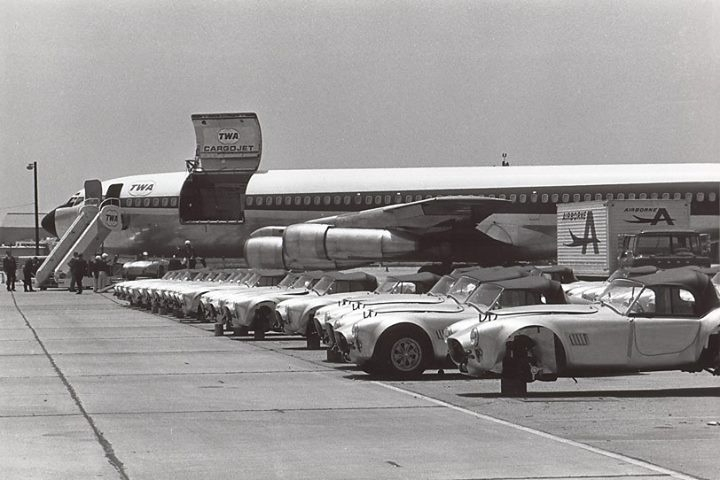
The 34 unsold competition 427 Cobras sitting in long rows on the airport tarmac represented something of a sales problem for Shelby American. At $9,500, the cars were expensive and there were only so many well-heeled SCCA racers desiring to compete in the top production class. Most of those who might have wanted a 427 Cobra race car already owned one. Shelby American’s Eastern Field Sales Representative, Charles Beidler, was visiting the factory and saw the line of uncompleted cars, their raw aluminum bodies gleaming in the southern California sun. When an order was received one car would be taken inside and completed to the customer’s specifications. With no orders, the cars just sat there. Beidler came up with an idea to liquidate the cars without slashing the price. He proposed that they be completed as “Semi-Competition” models and advertised as the fastest production cars ever sold to the general public. The idea proved to be a good one. During the time it took to complete them, three were ordered as full-competition versions. The rest, 28 cars, were sold as 427 Cobra S/Cs. Some would ultimately be raced.
AC factory records indicate that the first two coil spring Cobras were initially given (on paper) the serial numbers CSX2701 and 2702, but then it was decided that all coil spring cars would carry serial numbers in the 3000 series. The first two chassis were stamped “CSX3001” and “CSX3002.” Work on them began before the 427 competition body bucks were completed at AC Cars. Ltd. On CSX3002, the rear bodywork and front fender flares were actually carried over from the FIA and USRRC competition roadsters, but it had standard (not cut-back) doors.
It also had a 289-style grille and nose, and 289-style forward-braced roll bar. Two-inch wide strips of sheet aluminum were sectioned into the top contour of the fenders to allow the body to fit over the new, wider coil spring chassis. It is not certain that a body was built for CSX3001; it is thought to have been shipped as chassis-only. CSX3002 was completed at AC Cars on October 23, 1964. Both were shipped to the U.S. via air freight. CSX3001 went directly to Dearborn, to Ford styling for evaluation and it was built into the Bordinant Cobra, a silver roadster show car powered by a 289 Hi-Po engine with an automatic transmission. CSX3002 was sent to Shelby American where it was completed, painted Guardsman Blue with twin white stripes, and campaigned as a factory team car. It was used for development of the production 427 competition Cobras and also driven in competition by Ken Miles, Phil Hill and Bob Bondurant.
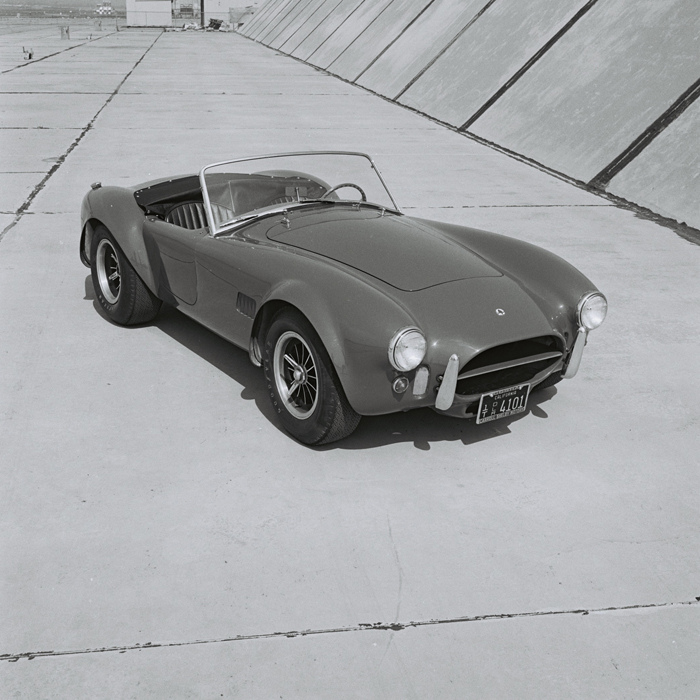
There were three 427 Cobra street prototypes. Each was shipped to Shelby American by air as soon as it was completed. The first one, CSX3101 [street 427 cars had production numbers beginning with “3101”] arrived on April 6, 1965. It was painted red. This car and two others, CSX3118 and CSX3120—had the standard (wide) rear fenders.
Before the first 427s arrived in the U.S., it had been decided that all street cars would be designated as 1966 models. As soon as CSX3101 was running it was extensively driven and evaluated. Problems surfaced immediately. The main one was excessive heat—both under the hood and in the cockpit. This heat had not been considered to be a problem in the race cars because it was expected (after all, they were race cars) and most SCCA races only lasted a half hour. And all of that was “at speed”—not in stop-and-go traffic. Within two weeks the heat problem had been solved with ducting.
Other issues which required solutions before the cars could be completed and shipped to waiting dealers included remarking of dipsticks (they read “full” at 4 quarts); special throttle linkage had to be designed and fabricated; crankcase ventilation systems had to be installed on all engines; the cast iron exhaust manifold for the driver’s side had to be redesigned and produced; speedometers needed to be revised; electric fan motors and blades were ordered and installed; cockpit ventilation was finalized (openings under the headlights were used to duct air into the cockpit; on the competition cars these intakes directed air to the front brakes); templates were required for pedal spacing, rear license plate mounting, side emblem locations, hood and trunk emblem locations, sun visor, wind wing and front bumperette placements.
Jim Benavides, Shelby American’s 427 Cobra Project Engineer, was working to have the first production street cars completed and delivered to dealers by the first week of September, 1965. However, a lack of wheels caused progress to grind to a halt. First, there was a shortage of “slave wheels”—the wire wheels and tires used during production at AC Cars and on which the cars were shipped. As they arrived at Shelby American these wheels and tires would be removed and sent back to AC Cars to be used on subsequent cars. There never seemed to be enough of them to keep the flow of cars steady and cars could not be shipped without them.
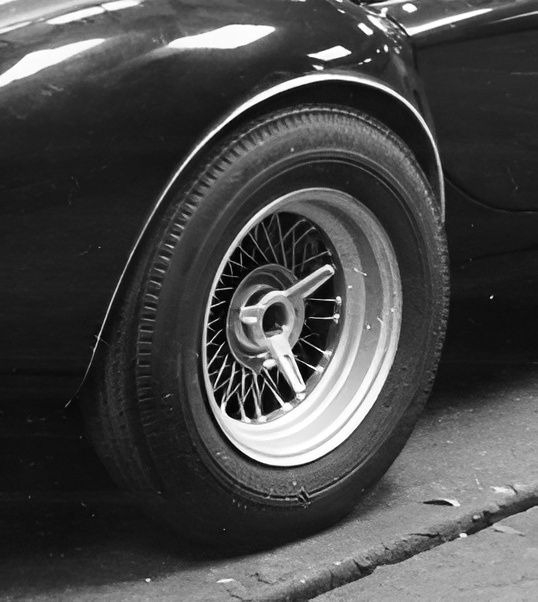
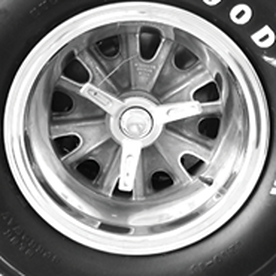
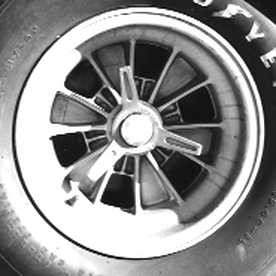
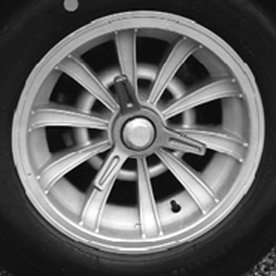
A wheel is a wheel... except when you don’t have enough of them. Leaf spring Cobras were shipped from AC Cars with wire wheels but coil spring cars got their alloy wheels in California, so “slave” wheels [left] had to be employed to ship the cars. These were actually leaf spring wire wheels mounted backwards so they would clear the larger brakes and the drive pins. They were held on by the 3-eared knock-offs (not pins or splines). It was originally planned that 427 Competition cars would use magnesium “GT40-type” Halibrands [second from left] in 7.5˝ and 9.5˝ widths. Street cars would use 7.5˝ Halibrands on all four corners. However, production problems at Halibrand left Shelby American without an adequate supply of wheels, so 6-spoke Halibrands [third from left] which had been used on 289 comp Cobras in 6.5˝ and 8.5˝ widths were pressed into service. Some comp cars got a combination of the two wheel types in order to get them into the hands of their owners—and onto the race track. Early street cars also got them. The log jam was broken when Shelby American’s in-house designer Peter Brock penned the Sunburst wheel [fourth from the left] for street cars. They were all 7.5˝ wide. Most of the narrow-hipped 427s received 7.5˝ Halibrands. No attempt was made to go back and refit street cars which had received Halibrand wheels with the new Kelsey-Hayes Sunbursts.
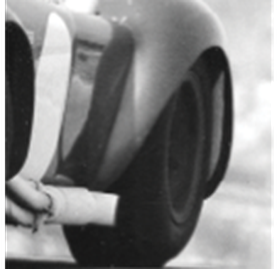
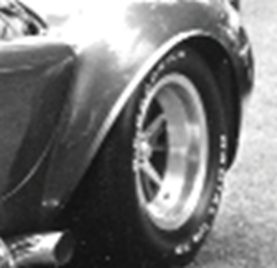
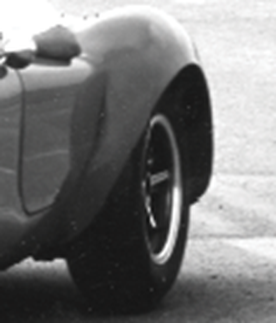
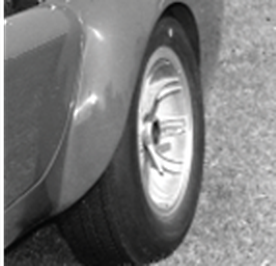
The first 427 prototypes were built using 289 body bucks, using 2˝ strips of aluminum to widen the fenders so they would fit the wider chassis. The rear fenders on competition models [left] resembled the rear fenders on 289 FIA/USRRC comp cars, only without the cutback doors. 427 S/Cs had an extra lip [second from left] because cars driven on the street used more suspension travel which required additional clearance because of rough pavement or abrupt elevation changes such as driveway aprons. The lip was pronounced at the leading edge and tapered off on the back edge; it was not constant around the entire wheel opening. Street model production began with standard rear flares [third from left], similar to those on the competition cars. Lips weren’t needed because the wheel width was only 7.5˝. However, the second batch of cars were built with narrower rear fenders [fourth from left]. These are often referred to “narrow-hipped 427s.” Fender configuration returned to the standard rear fender after 33 narrow-hipped cars had been produced because almost everyone agreed that the larger rear flares looked better.
The Halibrand wheels proved to be the real bottleneck. Shelby American placed an order for 7 1/2˝ wide GT40-type magnesium wheels for street cars and 7 1/2˝ and 9 1/2˝ wide wheels, of the same style, for the race cars. Halibrand, however, experienced difficulties in filling this order. Prior to the 427s, all of the later 289 competition Cobras had been using Halibrand magnesium 6-spoke “FIA” wheels so there were some of these on hand at Shelby American but it didn’t take long for this supply to run out. In order to get the first competition cars into the hands of the racers, many had combinations of the FIA and GT40-type wheels. By early November, only ten 427 street cars had been shipped to dealers due to the wheel shortage.
To put an end to this problem, Peter Brock whipped out a clean sheet of paper and designed the 7 1/2˝ wide “Sunburst” aluminum wheel for the street cars. It got that name because the ten spokes radiated out from the center like the rays of the sun. It was cast in aluminum by Kelsey-Hayes, and even these wheels were initially held up due to a machining error. Finally, in early December, Sunburst wheels began arriving at Shelby American in quantity and the 427 Cobra wheel problem became just a bad memory.
In early October of 1965, about the time the 80th street 427 Cobra was being shipped to Shelby American from AC Cars, the company started to experience problems getting 427 engines from Ford. On October 12th, Jim Benavides traveled to Dearborn and one of the purposes of this trip was to obtain information regarding the delayed delivery of 427 engines. He was given a tour of Ford’s Dearborn Engine Plant and upon his return he filed a report addressing these problems, parts of which are included here:
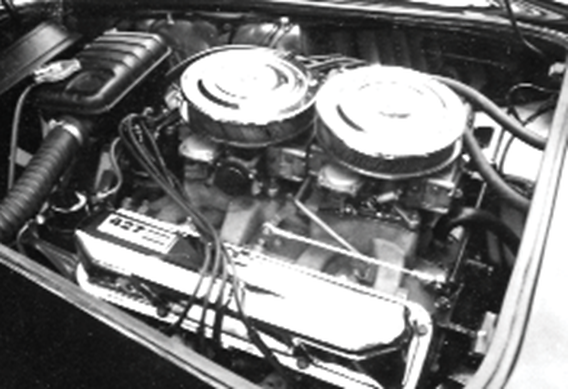
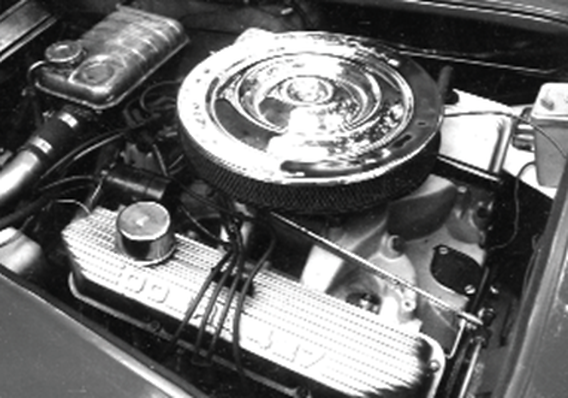
The first approx. 100 street cars received 427 low-rise engines with 2x4V carburetors on aluminum intakes. The next batch of cars (approx. CSX3200 and later) received 428 engines. These were Thunderbird Police Interceptor units with 1x4V carburetors on cast iron intakes which were painted blue, very likely exactly as they came from Ford’s Engine & Foundry engine assembly plant. After CSX3306, the 427 engines were once again used. They all had 1x4V intakes on aluminum medium-rise intakes. Obviously these are general approximations as the cars were not built in strict serial number order. As far as valve covers, Shelby American basically used what they had available. Most of the 427s used chrome pent-roof valve covers and most of the 428 engines had finned, cast aluminum “Cobra LeMans” valve covers.
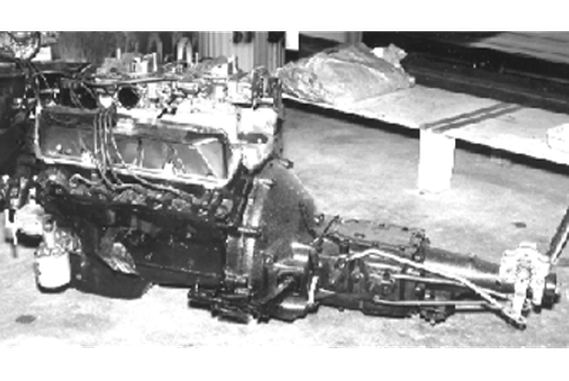
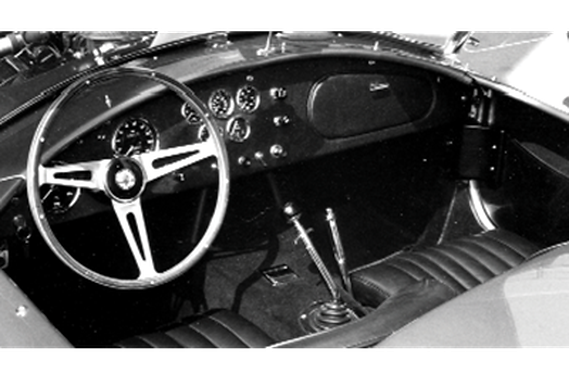
427 Cobras used Ford top-loader transmissions. The engine setback in the frame resulted in the shifter coming up through the transmission tunnel at the driver’s elbow. The solution was to turn the Ford shift lever around so it curved forward instead of to the rear. The shift pattern was the same but for the first-to-second shift, you pulled the lever up and back instead of merely back. Likewise, second-to-third was forward and down, and third-to-fourth was up and back. It may sound complicated but after a few miles it became natural.
“The 427 lightweight engines are constructed on the production assembly line. To complete one engine requires that six be put into process. The engine plant explanation is that for every lightweight engine built, they are set back six production vehicles. This will explain some of the high costs of this particular type of engine. A similar condition exists with the 427 solid-lifter production engine as that of the 427 lightweight engine. If Shelby American is to obtain engines for the next hundred car build, I can see no alternative but to incorporate the 428 as this is a production unit available from immediate stock or could be built to our specifications without lengthy delay in shipping from Ford Motor Company. The 428 engine produces 330 BHP with a maximum limitation of 5,000 RPM and through the use of a new hydraulic lifter cam, designed by Don Sullivan of Ford Engine & Foundry Division (whom I contacted to determine feasibility of using this engine in the Cobra), we can obtain 360 BHP with a maximum of 6,000 RPM.
“As management is well aware, the available power of the 427 cannot be transmitted to the ground on the current production car. It is strongly recommended that the 428 now being prepared for installation in CSX3118 be considered for the production substitute on the next hundred car build. This engine also simplifies the installation as no crankcase ventilation system need be installed by Shelby American. Only one carburetor needs be leveled as this is a single 4-V induction system. The standard fuel line need not be modified, thus reducing Shelby American labor by approximately one to two hours per vehicle.”
Another bonus was cost. The 427 engines were costing Shelby American $730 each. The 428 Police Interceptor engine could be had for $320 apiece. After evaluation of CSX3118, it was decided that the 428 engine would be used in the second hundred 427 Cobra roadsters. The car continued to be advertised, marketed and sold as the “427 Cobra” with this new engine, but a new brochure was printed to reflect the engine change. Ford Engineer Fred Goodell joined Shelby American on December 5, 1966 and one of the first things he did was to bring the 427 back. Goodell’s rationale was that since the cars were being called 427 Cobras, they should have actual 427 engines in them. No factory records have turned up detailing exactly when the change from 427 engines to 428s was made, but based on the Benavides letter it was probably around CSX3200. Goodell specifically recalled that 427 engines went into at least the last 47 Cobra street cars. Shelby American production orders show that all but two or three CSX3300 cars were built with 427 engines.
Four 427 Cobras received automatic transmissions at the factory. Two of these were special, dual-Paxton supercharged 427s which were custom-built for Carroll Shelby (CSX3015) and Bill Cosby (CSX3303). One of these (3118) was originally a prototype/test mule for the 428 engine. It was also used to evaluate the automatic transmission as a possible option (it was rejected). The other car (CSX3141) was an otherwise standard street car that was special-ordered (not CSX3118). The transmissions used were big, Lincoln cast-iron “Cruise-O-Matics” (not C-6s). An automatic shift lever from a 1965 Mustang was utilized and both cars also had a custom-made, extra-wide brake pedal that carried “COBRA AUTOMATIC” on a metal plate across the center, bordered top and bottom by black rubber. Specially fabricated exhaust headers were also required, in a Tri-Y configuration, leading to the standard 427 dual exhaust with exhaust pipes exiting at the rear.
Other minor production changes for the 427 Cobra included the deletion of the lower oil cooler scoop after the 200th street car. Oil coolers were not used on street cars and eliminating the lower scoop provided the cars with slightly more front end clearance. More than one 427 Cobra street car had its oil cooler scoop modified by a concrete parking curb.
Approximately 32 cars received narrow rear fenders. After the first 25 street cars were built with the “standard” rear fenders, a new configuration was produced. These new rear fenders had less flare and were intended to be incorporated in all subsequent 427 street cars. However, after the run of narrow-fender cars had been completed, the decision was made to return to the standard rear fender configuration. The simple explanation was that original rear fenders just looked better.
When supplies of rectangular taillights ran out, aided by DMV complaints that the small, rectangular AC lamps lacked sufficient brightness and were difficult to see at a distance, they were replaced by twin round taillights. Only the top light was wired; the bottom one was a flat reflector. These lights provided better visibility than the old rectangular lenses and were used on all street cars after the first hundred. The last two 427 Cobras were advertised for sale by S&C Motors, the Shelby American dealer in San Francisco, in August of 1968.
The decision to terminate Cobra production was not one Carroll Shelby came to easily, because so much of his recent life had been wrapped up in these cars. As much as he loved the Cobra, he was not blinded by ego. He was wise enough to realize that any attempts to emasculate the car in order to make it comply with federal emission requirements and safety regulations would result in something other than a Cobra. Something that would only be a parody of its former self. Shelby was convinced that nothing was better than that, so that’s what he chose: nothing.
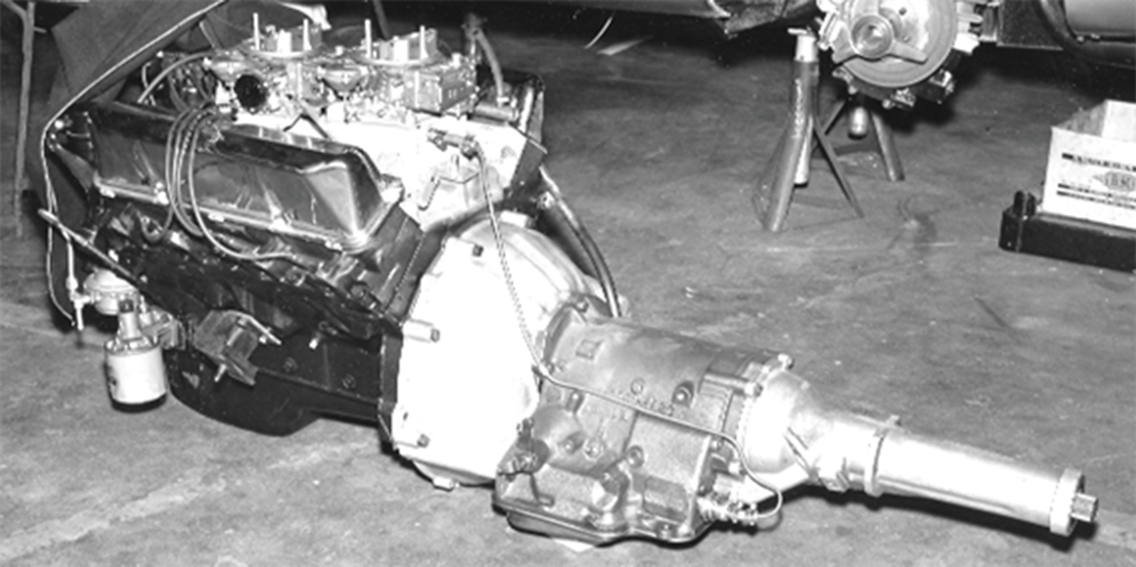
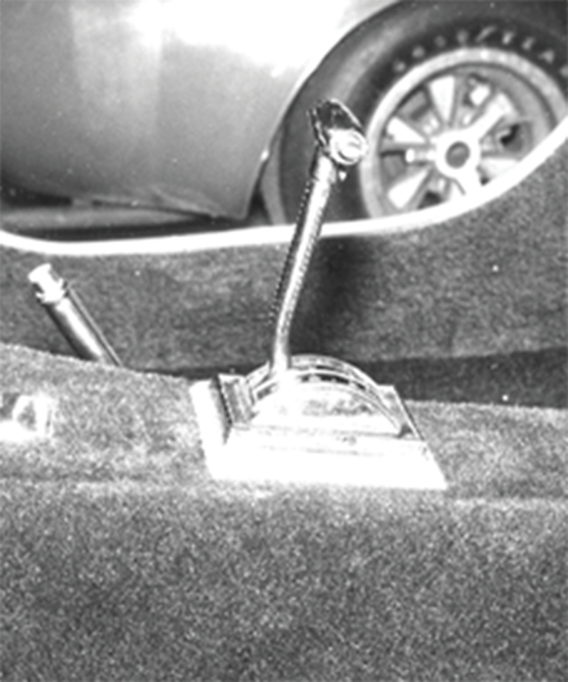
Four automatic transmissioned 427 Cobras were made. The C6 couldn’t take the torque so big Lincoln “Cruise-O-Matics were used. The first one was installed in CSX3118, one of three street prototypes. Two went into the twin-Paxton cars and a fourth (CSX3141) was special ordered. The shifter came from a Mustang.
Little did Shelby know that the years following the Cobra would result in a dark cloud descending over muscle cars. Federal emission standards, safety concerns and rising insurance rates for high performance cars like the Cobra all conspired against high performance. It was only a matter of a few years after the Cobra ceased production that the performance tide went out, leaving the 427 Cobra the high water mark. Even though it would be 25 years before performance the likes of the 427 Cobra returned, this car was still the ultimate yardstick that every other super exotic would be measured against.
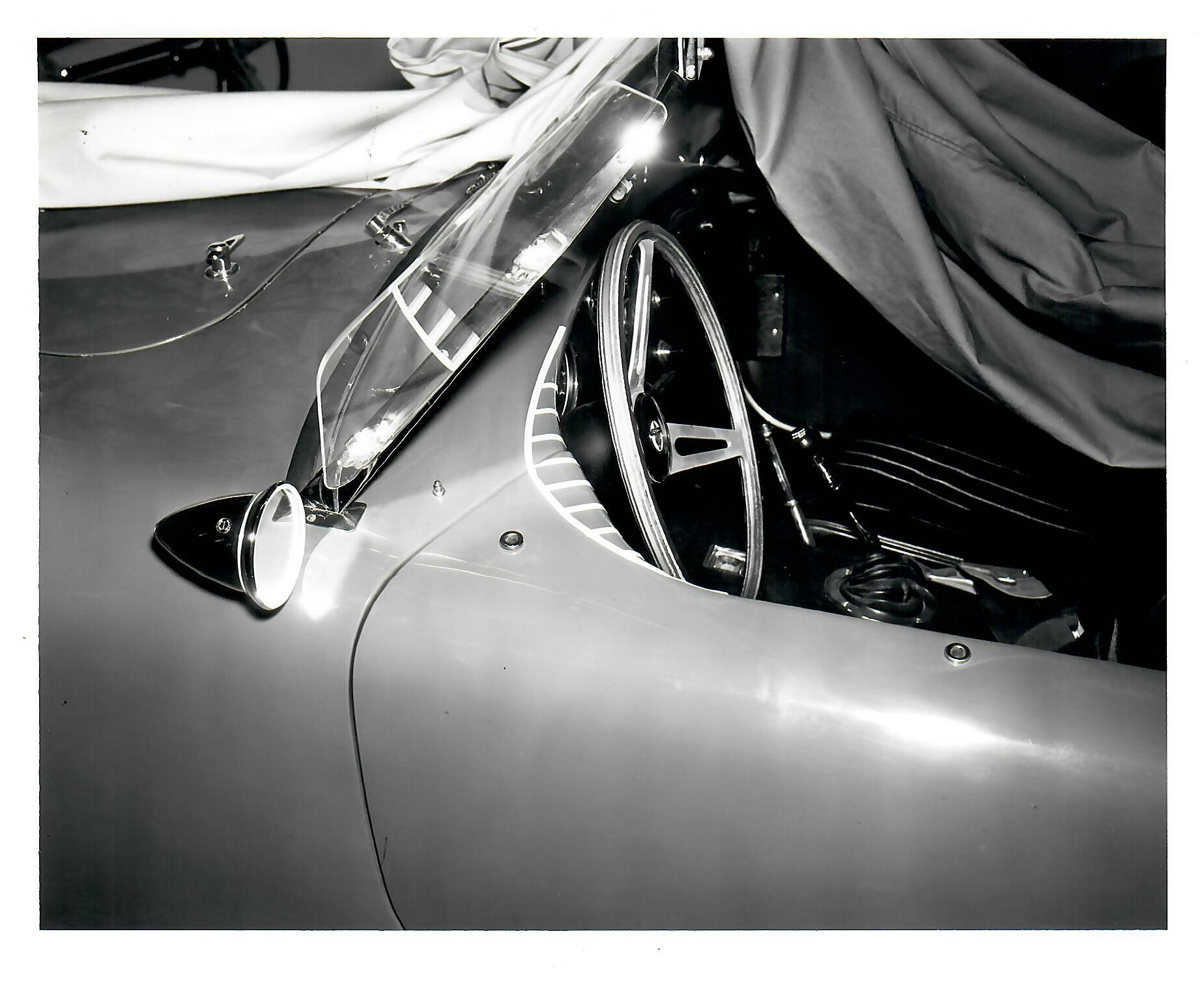
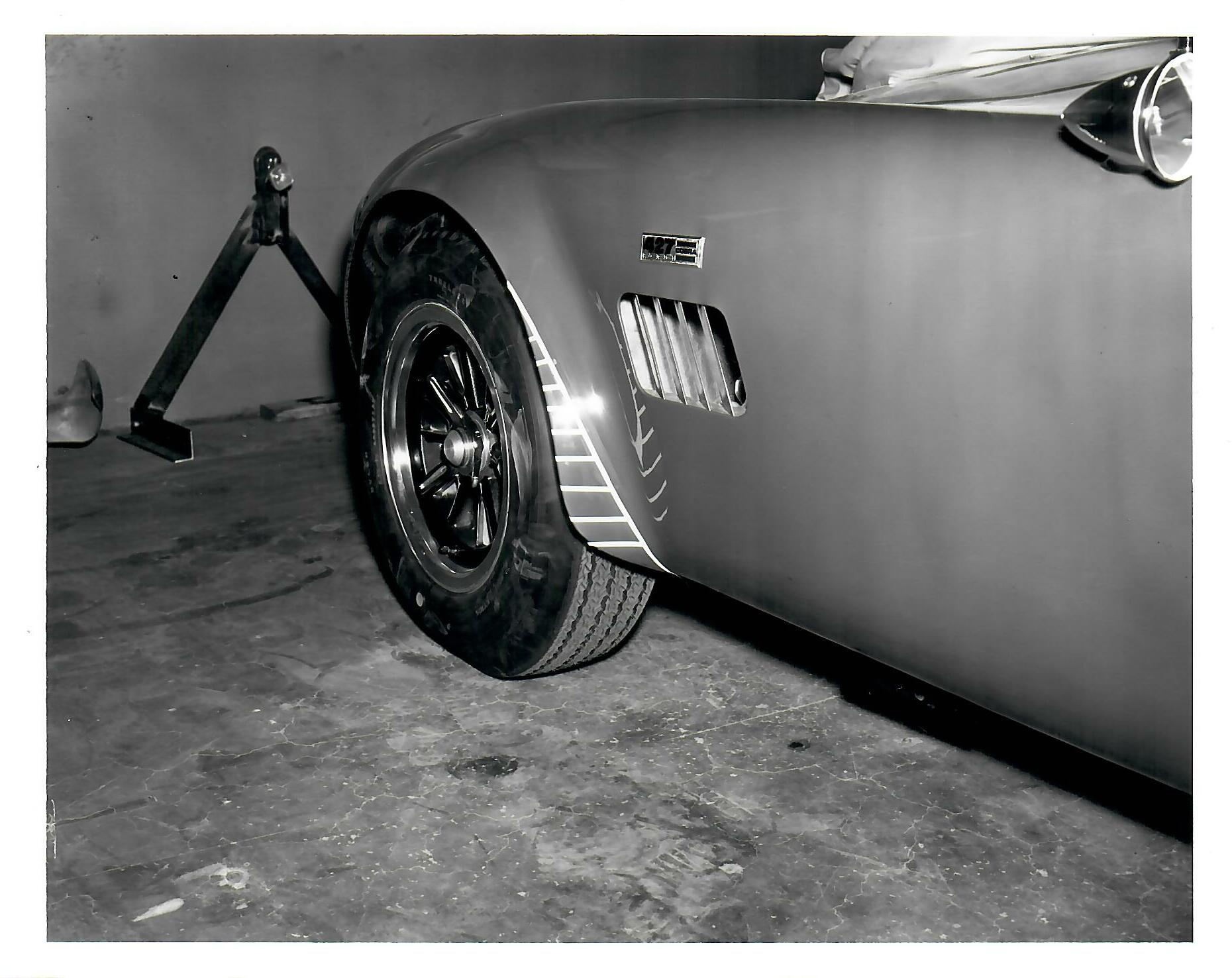
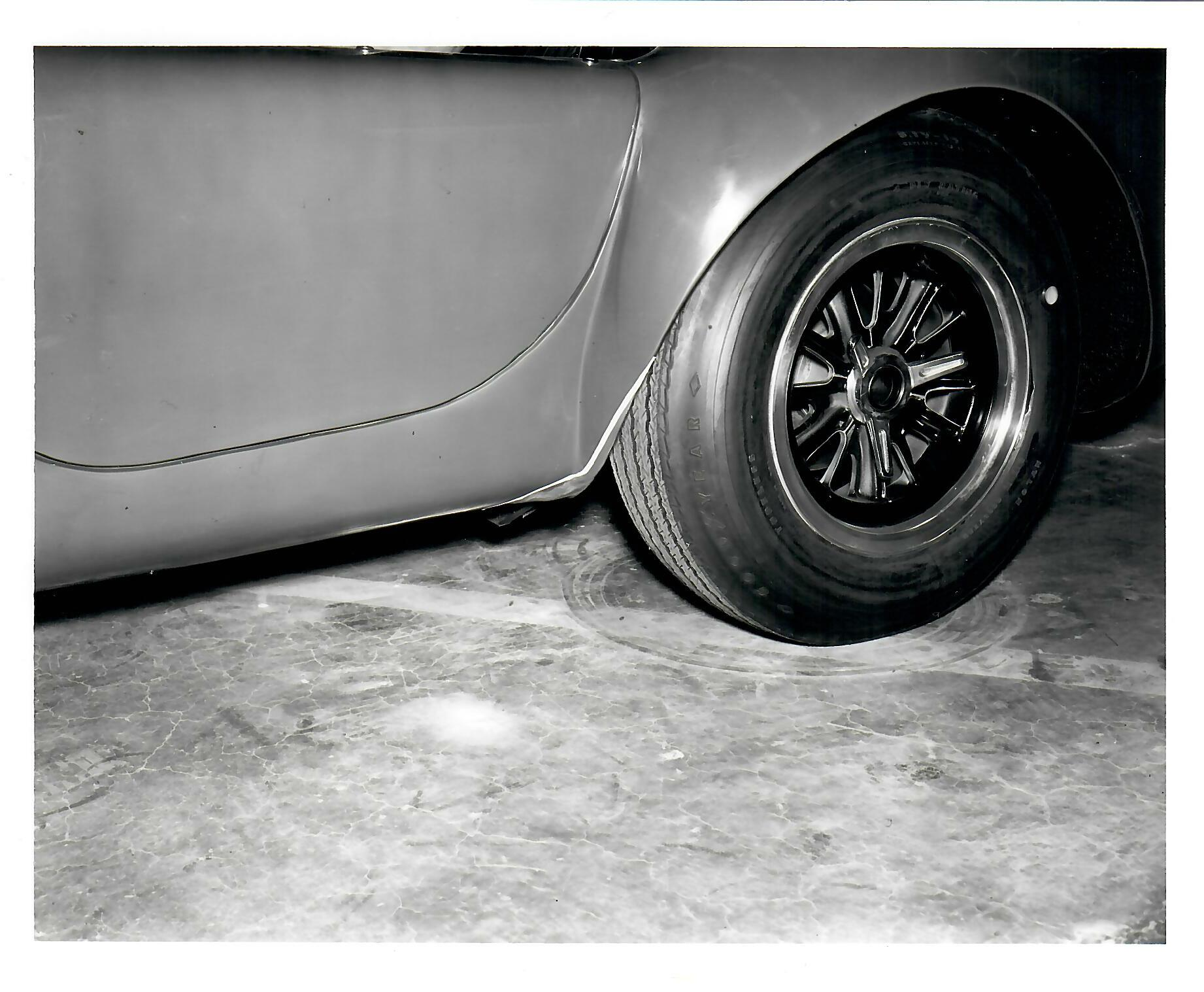
During the evaluation of the street prototype three changes were made to the body. The corner of the cowl was trimmed back to provide more room around the steering wheel [left]; the lower rear edge of the front flare [center] was trimmed back; and the lower front corner of the body/fender [right] was trimmed slightly.
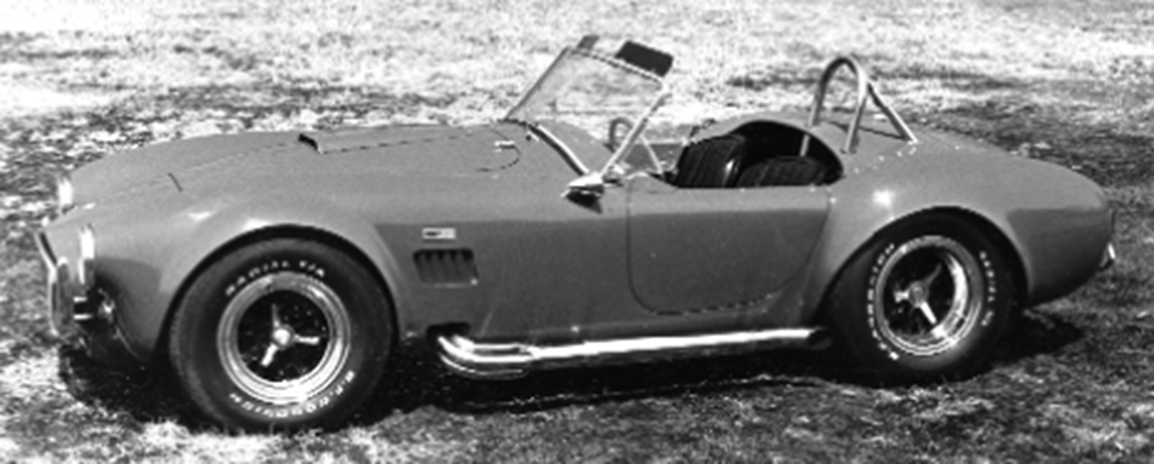
CSX3114 is typical of many street cars which owners have “S/C-ized” by adding Halibrand 7.5˝ and 9.5˝ magnesium wheels, roll bar, side pipes, hood scoop and comp fuel cap.
ZERO TO 100 TO ZERO – THE REAL STORY
The 0-to-100 MPH-to-0 test has come to be synonymous with the 427 Cobra. It has also become the yardstick by which super performance cars are measured. But it didn’t begin with the Cobra. Back in the 1950s, Aston Martin caught the public’s attention by boasting that their grand touring car could accelerate from a dead stop to 100 miles per hour and then back to a dead stop in less than 30 seconds. Back then, most cars had a difficult time reaching 100 miles per hour, period.
When the 427 Cobra hit the streets, Ken Miles recalled Aston Martin’s claim and decided to put a 427 Cobra to the test. He is reported to have taken a street model – without any special preparation – and timed the car’s acceleration and deceleration with only a stopwatch. Instead of using the speedometer, which wheelspin would have been rendered inaccurate, Miles merely cal
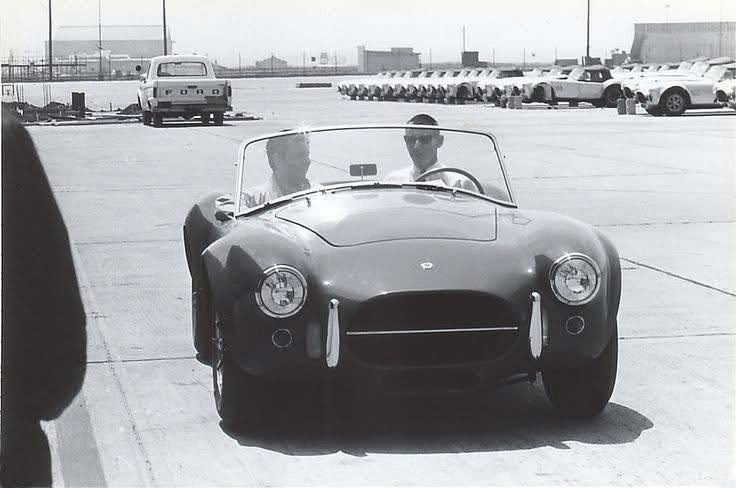
culated the speed based on RPM, rear end ratio and tire size. All he had to do was start the watch at the same time he launched the car, keep an eye on the tachometer until it reached a specific point (at which time he would be going exactly 100 miles per hour), and then stomp on the brakes. When the car came to a halt he stopped the watch. The result, according to Sports Car Graphic editor Jerry Titus, who was there, was an incredible 13.2 seconds. It should be noted that this was achieved on concrete, with street tires – narrow and fairly hard Goodyear Blue Dots.
Today, more than one magazine has attempted to use this test to evaluate cars such as the Viper, Porsche 930 Turbo and Lamborghini. Even with today’s Z-rated tires they have a hard time equalling Ken Miles’ record in a street 427 Cobra.
COLORS
Rangoon Red - 80 (31%)
Ivy Green - 56 (22%)
Guardsman Blue - 45 (17%)
Silver - 26 (10%)
White - 24 (9%)
Black - 18 (7%)
Charcoal - 1 (.004%)
Maroon - 0
Unpainted - 10 (4%)
Note: above totals are for 427 Cobra street cars only. All Competition and S/C models were delivered unpainted from AC Cars and were painted at Shelby American per customer order.
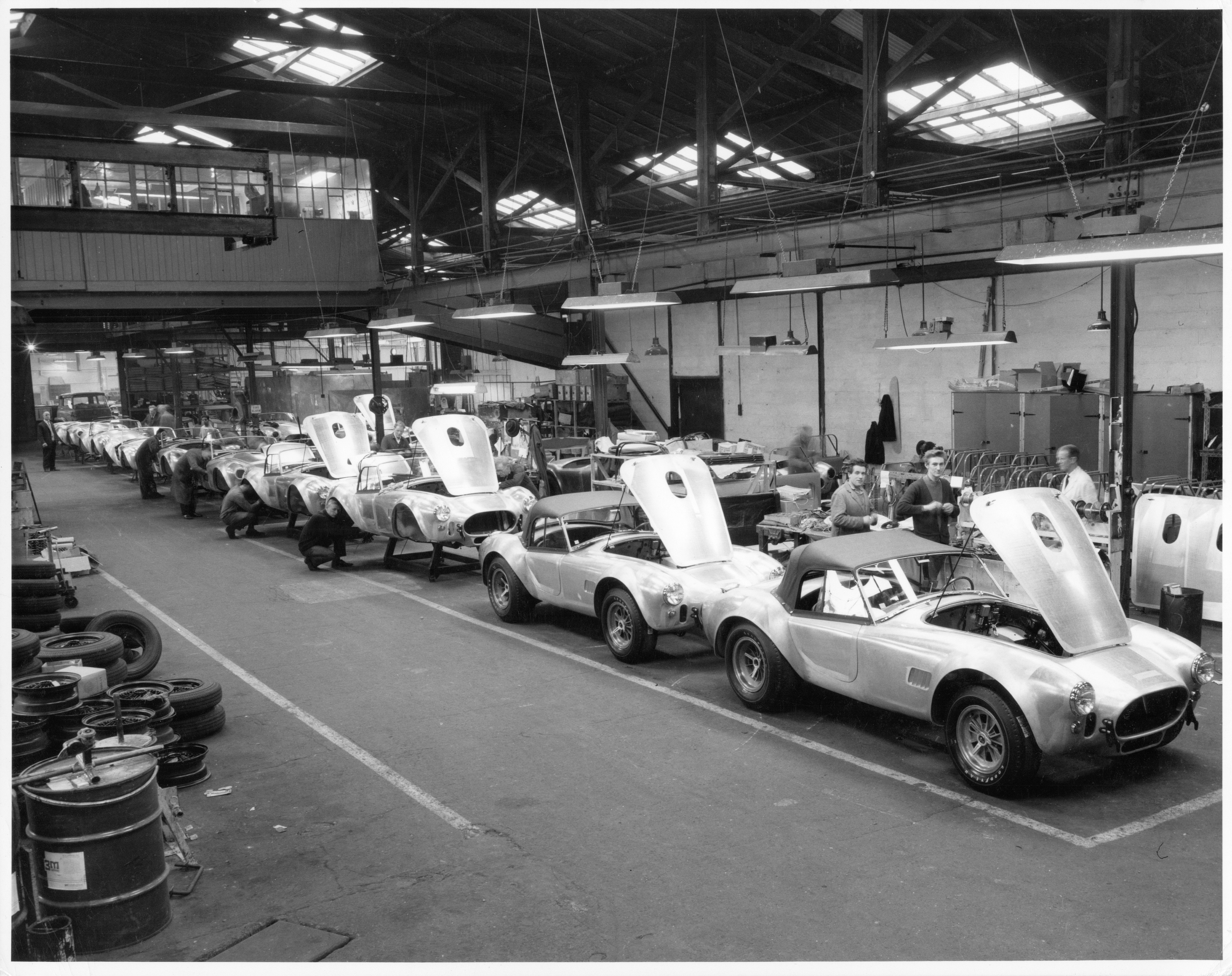
AC Cars production line for 427 Cobras in late 1964/early 1965. This was before street car production began; all Competition and S/C were shipped unpainted. Note slave wheels on the left.
OPTIONS
There were few actual options for the 427 Cobra. It was perceived as the ultimate high performance sports car which already came with everything it needed. The following items were available, as evidenced by their inclusion on factory sales invoices. In the vast majority of cases these options were dealer-installed.
radio
front & rear anti-roll bars
hood scoop
roll-over bar
magnesium wheels
RUNNING PRODUCTION CHANGES
CSX3001-CSX3055, CSX3063....competition chassis
CSX3101-CSX3360......................street chassis
CSX3101-CSX3200.....................427 engine
CSX3201-CSX3305.....................428 engine
CSX3306-CSX3360.....................427 engine
CSX3001-CSX3200.....................rectangular
taillights
CSX3201-CSX3360.....................round taillights
CSX3001-CSX3055....................competition rear flares
CSX3101-CSX3124....................wide rear
flares
CSX3125-CSX3158....................narrow rear flares
CSX3159-CSX3360....................wide
rear flares
CSX3001-CSX3300....................built with oil cooler scoop
CSX3301-CSX3360....................without oil cooler scoop
NOTE: The above breakdowns are approximate; actual numbers would require a physical inspection of each car as it left the factory.
WHEELS:
Most early 427 competition Cobras came with Halibrand magnesium 6-spoke “FIA” wheels. Later cars had GT40-style “S/C” wheels. Most narrow-fender street cars were equipped with 7 1/2˝ GT40-style S/C wheels, although many of the street cars that preceded them and almost all that followed had 7 1/2˝ aluminum “Sunburst” wheels.
The COB/COX series cars were equipped from AC Cars with 15˝x6˝ wire wheels on spline-drive hubs which were pre-drilled in a six-pin pattern for easy pin-drive conversion.
VEHICLE IDENTIFICATION NUMBER
LOCATION:
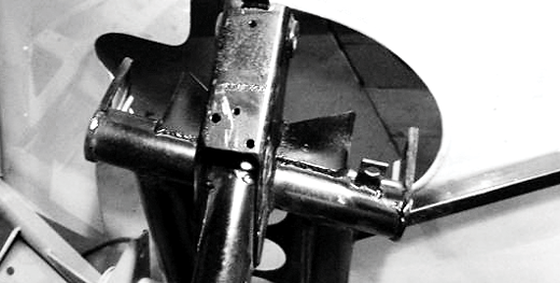
Stamped into the passenger-side shock tower above the spring perch; visible when leaning over the
passenger fender and located in an area approx. one inch to the outside of the horn mounting bracket.
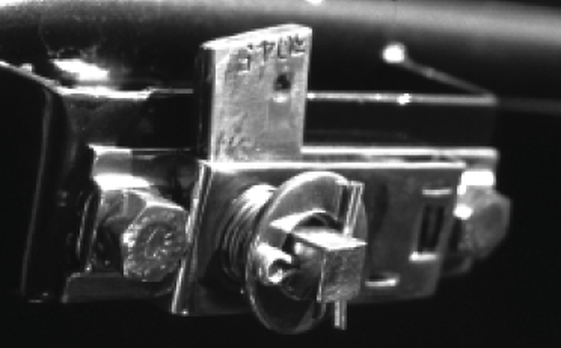
Stamped into the top of the driver-side hood latch (last 3 or 4 digits); visible when the hood is up and the
latch is locked.
Stamped into the top of the trunk latch, facing inward (last 3 or 4 digits); visible when
the trunk is open and the latch is in the locked position.
Stamped behind the leather pocket on the upper
section of the door hinge, facing out (last 3 or 4 digits); stamped on both driver and passenger sides.
Hand-written with an engraving tool on the underside of the aluminum transmission tunnel, on the exterior
surface towards the rear (last 4 digits); this is usually obscured by grease thrown off by the universal
joint.
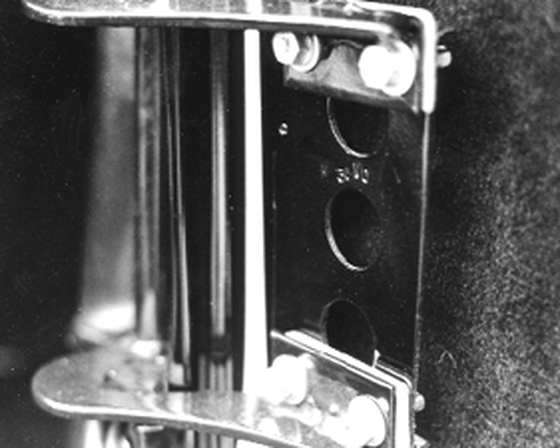
Hand-written with an engraving tool on the backside of the metal panel separating the cockpit from
the trunk compartment, on the top section facing the trunk.
Hand-written with an engraving tool or
hand-stamped on a unique aluminum plate riveted to the top of the passenger-side footbox; visible when the hood
is open.
SERIAL NUMBER BREAKDOWN
CSX - Cobra Shelby eXport (cars shipped to US) COB - CObra Britain (built for sale in U.K.) COX - CObra eXport (built for export outside of U.S. and U.K.) 3123 - consecutive production number (CSX cars begin with 3001 and end with 3360; COB/COX cars begin with 6101 and end with 6127).
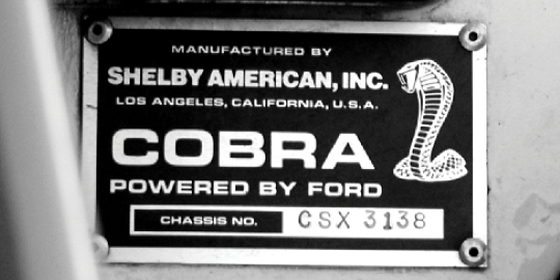
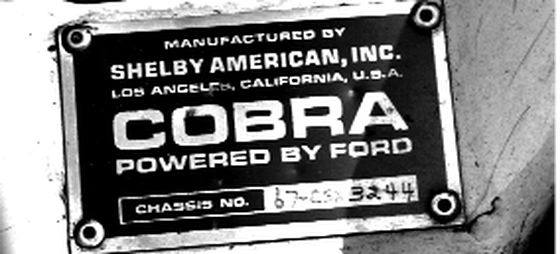
Three different aluminum serial number plates were used on 427 Cobras. The COBRA plate [top] was used on Competition and S/C models as well as some street cars. The number was hand-engraved using an electric engraving tool. The AC Cars plate, used on leaf spring Cobras [see photo in leaf spring section] was used on narrow-hipped street cars as well as on some mid-numbered 427 cars. The CSX number was hand-stamped at AC Cars prior to their being shipped to California. The third plate had a coiled 1967-style snake [below]. It was used on most cars over CSX3300. Cars with lower serial numbers which were unsold by late 1966 were “updated” to 1967 models. As such, they received new MSOs specifying that they were 1967 models. The VIN plate was often hand-stamped (not engraved).
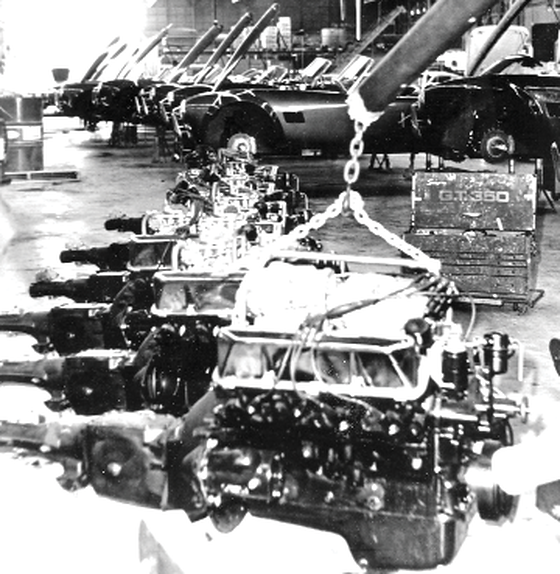
427 Cobra assembly line at L.A. airport facility.