Over the years, tracks with names like Daytona, Sebring, Targa Florio and LeMans have become synonymous with the 289 Cobra. The races at these venues, in which Cobras demonstrated clear dominance, varied in duration from 4 to 24 hours. The distances were measured in hundreds of miles or thousands of kilometers. But there was also a group of tracks whose names are not as well known—Pomona, Indianapolis Raceway Park, Fremont, Arlington. The races run at these places did not last for hours, or even minutes. They were over in seconds and the length of the track was a mere 1,320 feet. We’re talking about drag racing, and the Shelby creation that dominated in these events was the Cobra Dragonsnake.
More obscure than the FIA Cobra or the Daytona Coupe, the Dragonsnake nonetheless proved that the Cobra was capable of winning anywhere it was raced. There was another unique aspect to the tale of the Dragonsnake. Most of the Cobras racing efforts began with a target specified from the top. Carroll Shelby himself, or Ford in Dearborn, would announce a goal—such as winning the USRRC Championship. Then it was up to the mechanics and fabricators in the race shop and the team of factory drivers to make it happen. However, the idea of building a Cobra to drag race actually came from a few guys out in the production shop. Their simple idea —to wangle some kind of factory car to go drag racing— eventually led to the creation of a special drag race model and an entire product line of drag race parts.
In 1963 the Shelby American facility was actually two separate buildings. The main one was located on Princeton Drive and it housed the front office, the race shop and the engine shop. Additional room was needed to assemble production cars, so a vacant building located across the street was leased. It actually had a Carter Street address and, in fact, was referred to as “Carter Street” by everyone.
There was a very definite pecking order at Shelby American. Those working in the race and engine shop had the most prestige. Their jobs were never boring and required some degree of creativity. They often accompanied the cars to the races and returned with stories of their experiences that made the workers in the production shop—whose work seemed to be repetitive, day after day—salivate with envy. Headlines were made by the guys in the race shop—that’s where the glory was. Those in the production shop could only hope to get transferred if they proved themselves... and if a spot opened up.
The production end of the business was no less important. The street Cobras paid the bills which enabled the team cars to go racing. There just wasn’t very much sparkle or pizzazz there. Shelby American’s production department was headed up by Leonard Parsons. He was no stranger to car building and fabrication; a few years prior he and Phil Remington had worked for Lance Reventlow, building his Scarab race cars in the very building Shelby American was now leasing. Remington was responsible for the development of the race cars as well as finding solutions for any problems which surfaced with the street cars. Parsons was in charge of the production shop.
The first Dragonsnake was CSX2019, a worm-and-sector car from the company’s inventory. Previously it had been rented to MGM and was used in the Elvis Presley movie, Viva Las Vegas. A running joke about the drag Cobra was that it didn’t need a driver— just someone to aim it down the drag strip. When the car was lettered, Tony Stoer became identified on the door as the “aimer.”
One of the challenges he continually faced was that almost everyone there wanted to be across the street, working in the race shop. The less glamorous production shop naturally attracted younger, less experienced help. In fact, the race mechanics and fabricators referred to the production shop as “Father Flannigan’s Boys Town.” A lot of the entry level production employees came right out of high school. Whether Shelby recognized it or not, in Leonard Parsons he had the perfect Production Department Manager. Parsons was a skilled fabricator and builder in his own right, but he preferred to work in the production end of the Cobra business. He had no real desire to head across the street to the race shop. The thirty year-old was a stabilizing influence on his youngish crew and it was a perfect match. They possessed youthful exuberance and he had the maturity necessary to keep them directed.
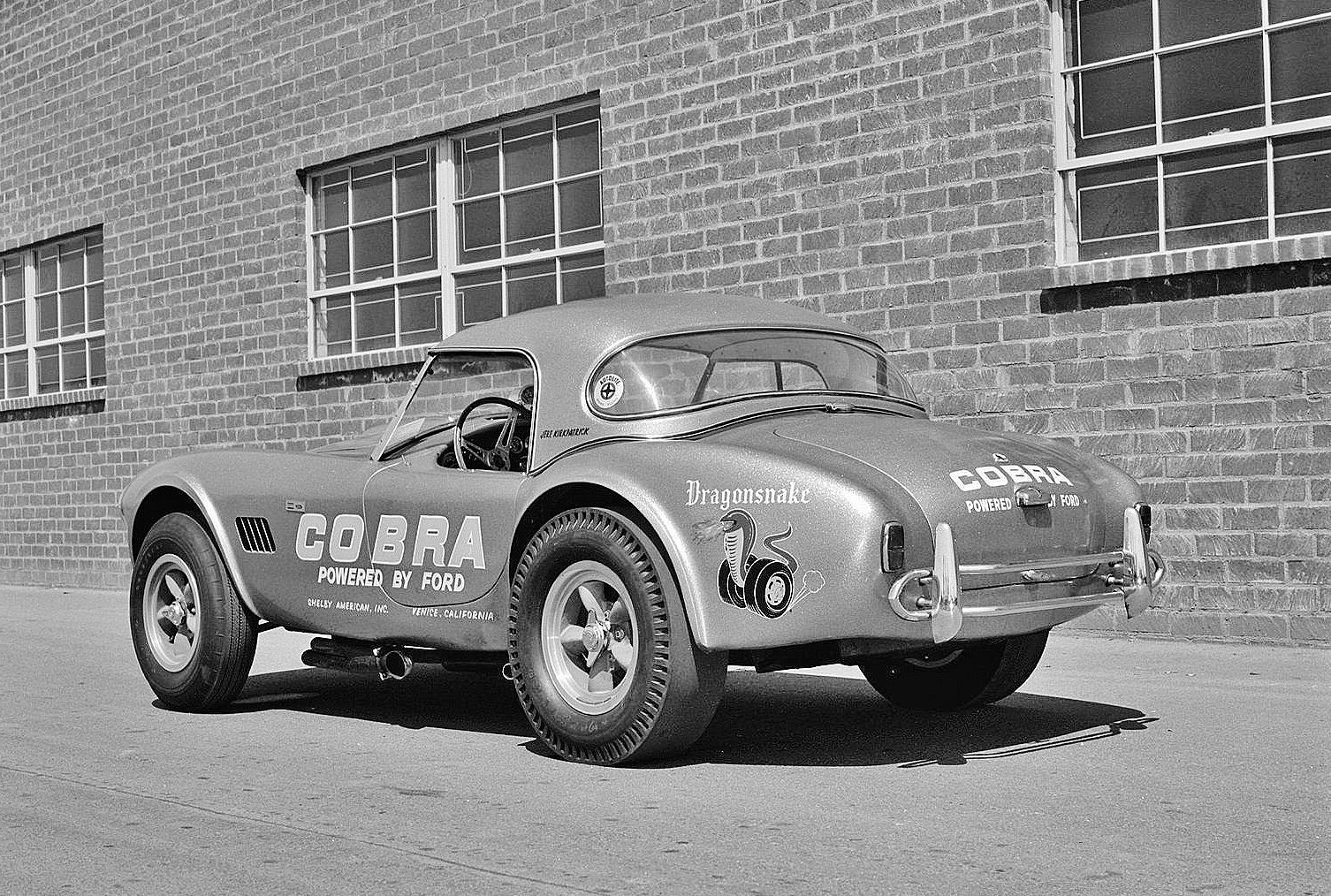
Tony Stoer poses with CSX2019 at Shelby American. The hardtop had not yet been painted to match the car’s Sun Gleam Viking Blue metalflake exterior. The Dragonsnake cartoon on the rear fender didn’t appear until the second car.
Things were not all that cheerful at Carter Street, and Parsons rationalized that this might just be the shot-in-the-arm he needed. He approached Shelby with the guys’ idea and after a couple of meetings with the boss he came back across the street with the good news: Shelby had agreed. It was not a blank check deal; there would be certain terms and conditions. But the exciting news, which no one had expected, was that they would get a Cobra to race—not the Fairlane. Support would be in the form of a company pickup, a trailer and gas to get back and forth to the track. Work on the car would be done solely by the employees in the production shop who formed the team, and it would be on their own time. Company tools could be used, and Shelby American would supply only a minimal amount of financial assistance.
Leonard Parsons, head of Shelby American’s Production Department, was now also the head of Shelby American’s Drag Racing Division. Initially, the plan was that the three employees would share the driving on a rotating basis and Parsons would accompany the team to each race. CSX2019, a worm-and-sector street car, was assigned to the Drag Team for transformation into what was to become a factory drag racing Cobra.
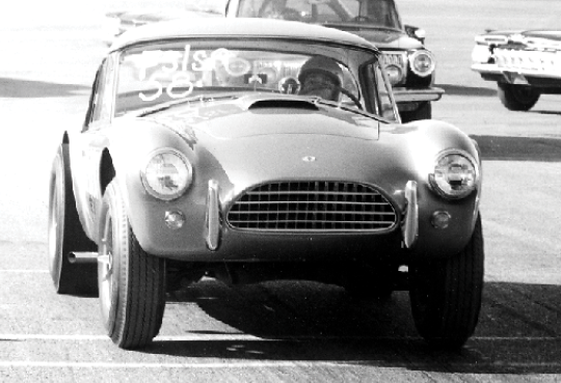
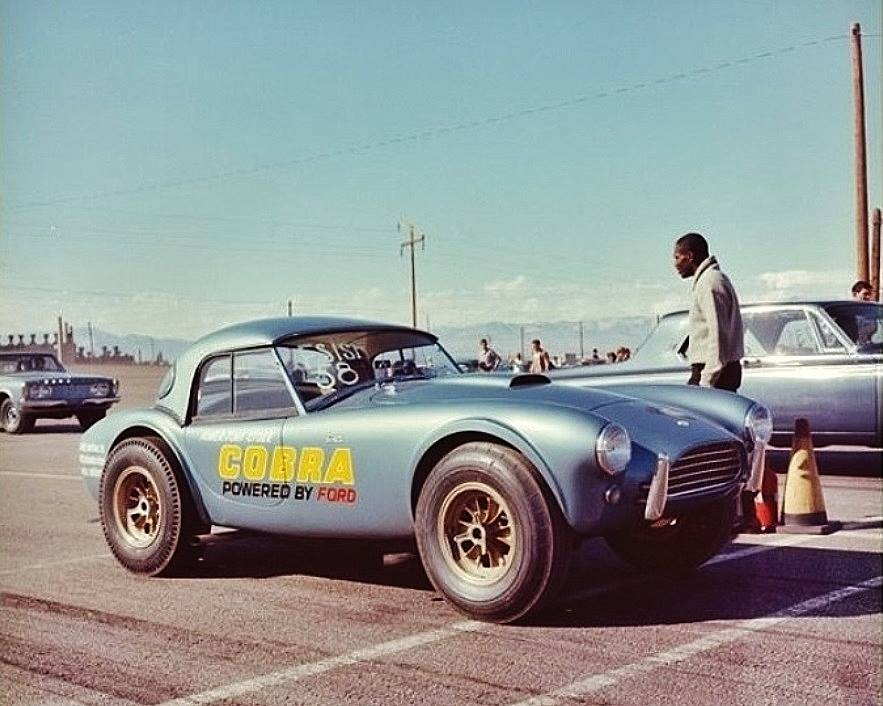
"Aimer" Tony Stoer gave nothing away in the weight department. He probably tipped the scale at 120 lbs soaking wet. Here he stages CSX2019. Sun tach is visible mounted on the cowl, directly in front of the driver.
The 260-engined car had arrived at Shelby American in late 1962 and was already well-known as the red car used in all of the Shelby American showroom literature and magazine ads. It had also been used (along with two other Cobras) in the MGM/Elvis Presley film "Viva Las Vegas." It is also suspected that this car was used in the movie "The Killers." It was returned to Shelby
American by MGM in late 1963. Its conversion from street snake into its mythical, fire-breathing relative was
not done in a blur of all-nighters. Rather, it was a gradual transformation that saw performance improvements
added one or two at a time. The 260 was replaced with a full-race 289 and the car was prepared for its first
outing, halfway across the country at the NHRA Nationals, held over Labor Day weekend at Indianapolis in 1963.
It was still red and still had its original wire wheels, soft top and chromed grille guard. One of the most
important items to a drag racer was a large Sun tachometer, and one was mounted directly in front of the
driver’s face.
Rather than rely on one of the three production department team members to drive at such a high-visibility
event, Motor Trend’s technical editor, Jim Wright, was asked to handle the driving chores. The Cobra was the
only Ford-powered entry in the large field of bowties and it ran well. However, just as it was beginning to show
some real promise it succumbed to a case of
just-too-much-horsepower-being-squeezed-through-too-little-driveline. A half-shaft broke and put the car on the
trailer before the final round of eliminations.
Whether the drag team knew it or not, they were now engaged in the “real world” of race car development, just like the big boys across the street in Shelby’s race shop. Parsons, Stoer, Kirkpatrick and Shaw sat down and discussed the car’s shortcomings when they got back home. They continued this practice after each race. They tossed ideas back and forth and jointly came up with suggestions to make the little Cobra go faster while still remaining reliable. It was a true “design by committee” project and for those who criticized that approach, citing as an example that a camel was actually a horse designed by a committee. In this case, it worked.
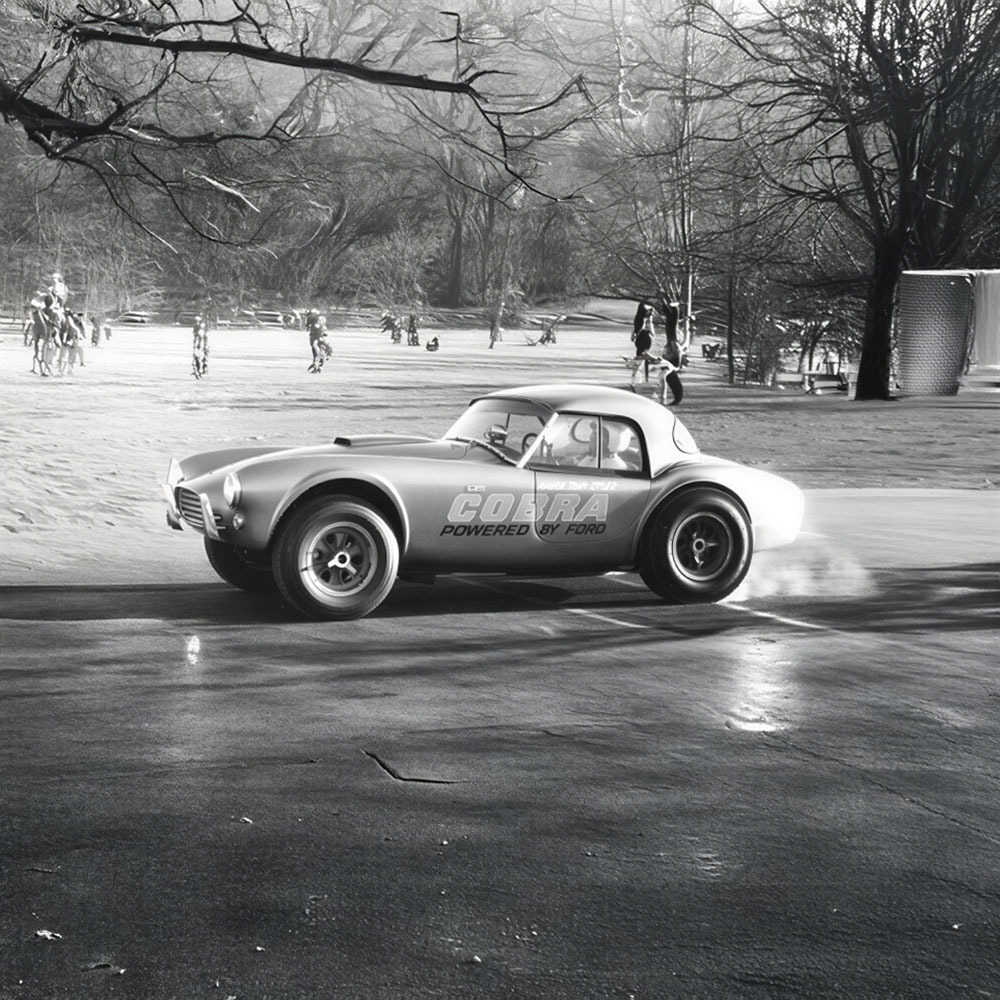
Powerplants were provided by Shelby’s engine shop but they came with a “don’t-touch-the-engine” edict. With just about everything else, however, the Drag Racing Department was pretty much on their own. The Cobra soon sprouted a hood scoop and they had no trouble coming up with a set of six-spoke Halibrand magnesium wheels. It was felt that a Cobra hardtop would improve aerodynamics, thus improving performance, so one of those was procured. Nassau headers were added and a stump-pulling 4.89:1 rear end gear was installed. Drag slicks were a necessity, and to make room for them the flat portions of the rear fender flares were trimmed and the lips hammered flat, producing a small flare.
The basic Cobra suspension needed very little attention. Getting the power to the ground was mostly a matter of managing weight transfer. Special Cure-Ride drag racing shock absorbers were employed. When the car was launched, weight was transferred to the rear, causing the front end to lift. The front shocks (called “90/10 Up-Locks”) extended when the body lifted and then maintained that position for a few seconds, holding the front of the car up as momentum increased. As speed was gained they compressed again, trimming the car out. At the same time the front shocks were extending, the rear shocks (“50/50 Down-Locks”) compressed as the weight transferred to the rear and they held in that position for a few seconds.
One other modification was necessary to the leaf springs. The front spring was re-arched 2 1/2≤ lower and lengthened 5/16≤. This allowed the front tires to maintain a neutral camber when the front end lifted during weight transfer. The rear leaf spring was lengthened 3/8≤ to prevent the rear wheels from leaning inward and, as a result, reducing the tires’ contact surface.
Once the fenders required bodywork, new paint was a logical next step. They chose a light blue metal flake (Sun Gleam Viking Blue). Large “COBRA” letters were painted on the sides in yellow. In response to a comment that the car didn’t need to be driven but merely aimed, “Aimer: Tony Stoer” was lettered on the doors. The original plan of having drivers alternate had never really worked out and Stoer pretty much became the sole pilot.
In one of its earliest events, at Henderson, Nevada, Stoer aimed the snake down the strip at a record 12.26 seconds/114.06 mph. The car was run at as many local events as it was possible to conveniently get to. The end result was that a couple of times each month, the Dragonsnake’s odometer increased in quarter mile increments. Cobras were fairly new in 1963 and they were rare birds as it was. As Shelby American’s Dragonsnake began to show up at drag strips across southern California the car attracted a lot of interest. How did it work? The best answer would be that the car set the A/SSP record – 12.81 seconds @ 108.95 mph – at the AHRA Winter Nationals held at the appropriately-named Beeline Dragway in Scottsdale, Arizona in February 1964. In a follow-up appearance in Fresno, Stoer actually bettered his time by a half a second, but because of a minor rule infraction (he had neglected to seal the fuel filler after gassing the car—a rule designed to prevent any “funny stuff” from being introduced into the fuel tanks after filling with “legal” gasoline), his run was disqualified—to the obvious displeasure of Shelby American management. But when things went right (as they frequently did), the Dragonsnake truly “went like stink.” In fact, the Cobra was so much faster than other cars in its class that they would often let the competition launch off the line first, and then come from behind to, in the words of Dragonsnake driver Jere Kirkpatrick, “bury them at the finish.” The AA/SP best time of the Dragonsnake was 11.73 seconds @ 119.20 mph. There were so many local drag racing appearances by the Cobra drag team a race-by-race accounting of quarter mile victories doesn’t exist. If it did it would fill several pages. The Dragonsnake was that good.
A well-known photograph taken in 1964 illustrates just how “magnetic” the Dragonsnake was at attracting trophies from a considerable number of events in which it was run. Team members Stoer, Kirkpatrick, Shaw and Parsons are standing behind the Dragonsnake and the entire foreground of the photograph is loaded with just a fraction of the trophies the car acquired. CSX2019 was run for about eight months before it was replaced by a new Cobra. The first Dragonsnake was sold off to a private owner who continued to drag race it successfully for the next several years.
To replace the car, Parsons told Tony Stoer to go out into the shop and pick a new Cobra to be the next factory Dragonsnake. CSX2357 arrived at Shelby American in March of 1964. Stoer selected it by the rather unscientific technique that literally amounted to “eenie-meenie-minee-moe.” It was soon on its way to becoming a new and improved Dragonsnake. Rack-and-pinion steering had replaced the old worm-and-sector box in all Cobras and that was an improvement. The 289 engine was pulled and replaced by a full-race Cobra engine. Rack-and-pinion cars had the familiar cooling louvers in the front fenders and this provides a tip-off as to whether pictures taken during the period were of the first or the second Dragonsnake (because both cars had similar paint jobs). Drag modifications included a hood scoop, hard top, magnesium 5-spoke American wheels, Belanger drag headers and the obligatory Sun tach. The rear fender flares were again trimmed, and the car was also painted a brilliant Sun Gleam Viking Blue metalflake. Like its predecessor, car #2 carried large “COBRA” lettering on the sides, but also featured a cartoon-like painting of a flame-spewing Cobra snake on two fat racing slicks on the car’s rear quarters along with the name “Dragonsnake” in Olde English lettering.
To maximize the car’s exposure, it was set up to run NHRA events (using a 2x4V Carter setup) and AHRA events (with Weber 48 IDAs and trick cylinder heads). Unlike the first Dragonsnake’s slow metamorphosis from street car to dragster, CSX2357 was turned into a drag car in what was essentially a one-shot deal. Almost literally, one day it was a street car and the next it was a drag car. The development work on CSX2019 was a trial-and-error process to determine what worked and what didn’t. By the time they were ready to build the second Dragonsnake, a pile of drag parts and a few hours effort were all that was needed. The development work had already been done.
Tony Stoer did almost all of the mechanical work to transform CSX2357 into a drag car. Having done both the driving and the wrenching, he recalls that his brief foray into testing and development driving took place on a Saturday night. At around 10 p.m. he telephoned Leonard Parsons to let him know that the car was done and ready to go. Parsons told Stoer to test the car and he figured, what better time than right now? And what better place than Sunset Boulevard? So in the waning hours of a Saturday night, Stoer fired up the Dragonsnake, aimed it down the largely-deserted street and stomped on the throttle. Fortunately, the test session was uneventful, but Stoer now knew firsthand what the racing guys meant by “out-driving their headlights!””
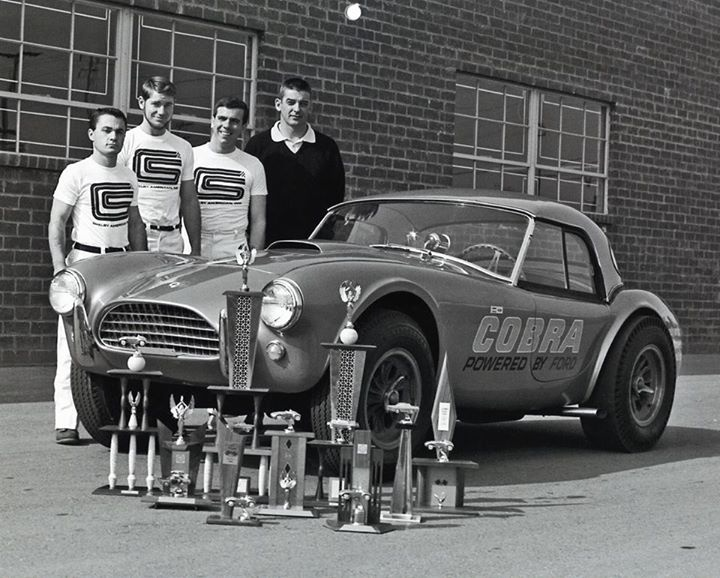
The Dragonsnake Team [left to right]: Tony Stoer, Jere Kirkpatrick, Randy Shaw and Leonard Parsons. Trophies are only a portion of the loot CSX2019 accumulated.
The new car’s first actual race would be the first-ever Hot Rod Magazine National Championships, held at Riverside Raceway on June 13, 1964. Tony Stoer, the regular driver, was unavailable because he had recently answered a call from his Uncle Sam. He was drafted into the army and so, it turned out that his test drive down Sunset Boulevard was the only time he ever drove CSX2357. Stoer’s involvement with Shelby American was over, except for a brief visit to Shelby’s new facility at LAX after he had completed Basic Training. He was surprised to find that the place had been overrun by Mustangs!
Jere Kirkpatrick took over the driving chores and when it was all said and done, he set a new class record of 12.00 seconds @
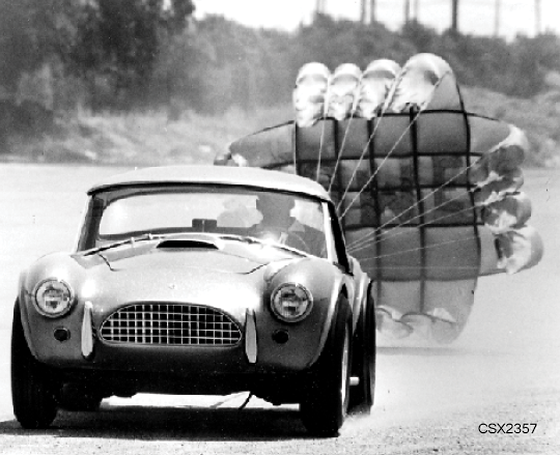
114.83 mph. The Dragonsnake was certainly attracting attention and its performance was noticed by everyone, including the upper management at Ford. When the drag team returned to the Los Angeles shop on Monday, after their Riverside victory, a telegram from Dearborn was waiting. It was not so much a congratulatory message, but more of an edict: you WILL campaign the car in all major NHRA and AHRA events and Jere Kirkpatrick WILL drive. Now aimed solely by Kirkpatrick, the car set records in the NHRA A/SSP class with a best time of 11.81 seconds @ 116.27 mph at Fremont, California on July 18, 1964. A publicity photo of the car, charging right at the camera with a drag chute billowing out behind it, became a widely circulated factory publicity photo. Shelby American soon discovered there was a demand for drag race parts and even for a handful of turnkey drag models.
Shelby American’s drag race program was originally a means to channel the energies of a handful of enthusiastic young employees in a direction other than towards Shelby’s office. He had given them a toy to play with, but it now seemed that they had tapped into a vein of performance the company had overlooked. Things were quickly cranked up to correct that. The drag race parts offered to customers had already been “tested” on the factory Dragonsnakes. By September of 1964, the company that made its reputation in road racing was offering a unique drag race model as well as the specialized parts that enabled customers to build one of their own just like the factory car.
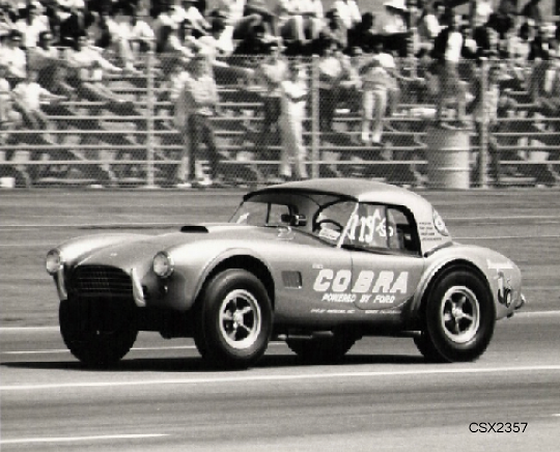
The turnkey Dragonsnake was available in four versions, or stages, depending on the amount of horsepower the 289 cubic-inch engine developed. The cars were otherwise the same. The Stage I engine, rated at 271 horsepower, was essentially a stock specification 271 Hi-Po with a 2x4V intake setup. Stage II was rated at 300 horsepower. The additional power was the result of a higher-lift camshaft along with the 2x4V set-up. The Stage III engine was rated at 325 horsepower. It was basically an R-Model engine with a 2x4V setup: it also had a higher compression ratio, some porting of the heads and a high-lift camshaft. The Stage IV, rated at 380 horsepower, was the basic Cobra race engine with ported & polished heads, 12.5:1 compression, a radical camshaft and a set of 48 IDA Weber carburetors. It was legal only in AHRA-sanctioned events. The other stages were legal for NHRA events.
There were several drag race classes for sports cars, calculated on a formula of weight vs. horsepower. When someone purchased a turnkey Dragonsnake—or prepared one on their own— the level of horsepower was critical because it determined the class they would compete in.
All of the unique drag racing components used to make up the Dragonsnake were available separately, including complete engines. This enabled owners of Cobras who decided to campaign their cars at the strip to create their factory Dragonsnake as their budget allowed, rather than plunk down a sizeable amount of money and have everything done for them.
Spreading the word about the Cobra’s ability to dominate its class on the drag strip was initially left to word of mouth which followed the appearances of Shelby American’s factory drag team as they campaigned the first Dragonsnake around California drag strips. As word spread and interest grew, so did the demand for unique drag race parts. Once the Dragonsnake was finalized into a separate model and the list of drag parts was compiled, it was time for a real advertising campaign.
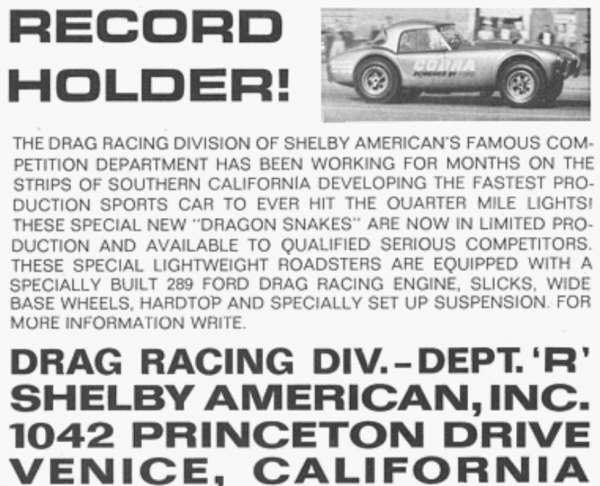
Shelby American’s marketing department came up with a magazine ad which, quite logically, was run in hot rod magazines of the day. It boldly proclaimed “RECORD HOLDER!” and featured a photo of the first Dragonsnake, CSX2019, launching off the line. The text mentioned that “several months worth of development” had been done on the factory drag Cobra by Shelby American’s Drag Racing Division (a subsidiary of its vaunted Competition Department) and that a limited number of examples were available to “qualified competitors.” The ad didn’t exactly state what the qualifications were, but it’s pretty safe to assume that the level of qualification was directly proportional to the number of digits in the buyer’s checkbook balance.
An impressive aspect of the ad (which was transparent to the casual observer, and therein lay its beauty) was the wording of the ad. It made it appear that a concerted drag racing R&D program at Shelby American had been running for some time, and the Dragonsnake and its components were the final result of hundreds of hours of development work. In actuality, the drag parts line was a hastily-conceived response to a few production shop guys taking a Cobra drag racing, being very successful, and catching people’s attention. With individual parts, complete engines or complete vehicles being available to drag racing Cobra owners, Shelby American provided several paths to quarter-mile victories.
One reminder of the low-budget aspect of the drag program occurred when McCain returned from one of his many road trips. Arriving back at Shelby American, he discovered that the Dragonsnake had two cracked cylinder heads. No problem, he thought, as Shelby American was literally awash in 289 heads. But when he asked around for a pair he was told—repeatedly—that there was nothing in the budget for drag car repair parts. His plea fell on many deaf ears, including those of Competition Manager Al Dowd. Someone finally came through and when McCain returned from his next business trip, there, on the front seat of CSX2357, were two cardboard boxes, each containing a brand new 289 Hi-Po cylinder head. It is believed, but was never actually confirmed, that Dowd was the anonymous benefactor.
The year 1965 saw not only a driver change, but also a color change for Dragonsnake #2, to a darker metallic blue. The “COBRA” door lettering was gone, replaced instead by the satanic number “666.” Hi Performance Motors (one of two sponsors, Shelby American proper being the other) was lettered in yellow on the front fenders. In its new, darker blue paint, the car set 1965 records in NHRA and AHRA in A/Sports Production classes.
Since Shelby American campaigned the same cars they sold, on occasion the planets would fall into perfect alignment and the factory Dragonsnake would find itself paired off against a customer Dragonsnake. This is exactly what happened at the 1965 AHRA Winter Nationals at Beeline Dragway in Scottsdale, AZ. The event turned into something of a Dragonsnake convention. Don McCain, in the factory Dragonsnake, drew the Cobra (CSX2093) of Costilow and Larson. McCain won handily. He continued to win each heat until finally he was side by side with another Dragonsnake in the final: CSX2248, the black “El Cid” of Hans Schmidt. To say that the cars and their respective drivers were evenly matched is an understatement. Both machines reached the finish line in exactly the same time—11.51 seconds. However, a close look revealed that McCain actually won by a whisker and the title went to Don McCain in the factory Dragonsnake, CSX2357.
With the national title now secured, what happened next was anticlimactic; in fact, few can recall if the factory Dragonsnake ever raced again. There might have been one or two local races (easy wins, to be sure), but those results have been lost to history. In May of 1965, CSX2357 was finally parked for the last time, being consigned for sale to Bill Stroppe. The reign of the factory Dragonsnake had come to an end, not because of any lack of competition (there were always attempts to take on the fastest gun). The project ended due to lack of money. The cars had blown through the meager drag racing budget and the well was now dry. This also meant that driver Don McCain was out of the drag racing business. His hiatus from straight-line work was only temporary, however. In very short order he was tagged, because of his experience, to head up an effort to create a drag race package for the GT350. By late June the second factory Dragonsnake was in private hands.
The Dragonsnake program ran essentially from Labor Day 1963 thru May of 1965. It used two cars and the talents of six dedicated, hard-working (and equally hard-driving) employees and left an indelible impression (actually, TWO parallel impressions, roughly 52 inches apart) on drag strips across the United States. Much of the effort put into the Dragonsnake program cost Shelby American nothing. Recall that the employees who formed the team worked on their own time, and the drag program’s operating budget was miniscule. Financially, Shelby American got a tremendous “bang for its buck,” and it spawned the creation of an entirely new line of cars and parts. It became one more area in which Shelby’s Cobra achieved dominance.
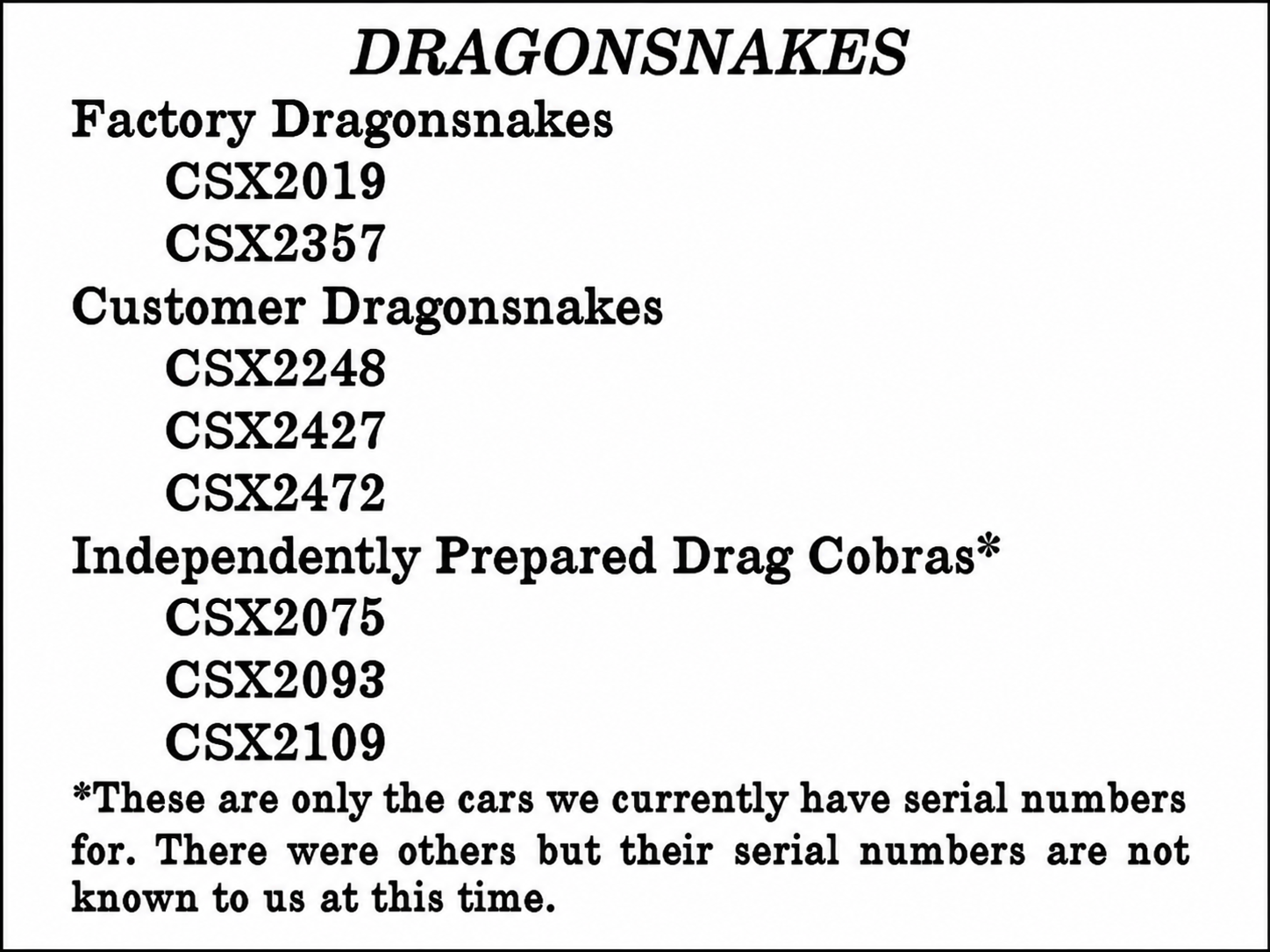
In the final analysis, there were five small block factory Dragonsnakes built. Two were Shelby’s team cars, CSX2019 and CSX2357. The rest (CSX2248, CSX2427 and CSX2472) were the result of buyers taking Shelby American up on their offer to build and sell complete, turnkey drag cars. Additionally, a handful of Cobra street cars were converted into drag race cars by their owners who used Shelby American’s drag racing parts catalog.
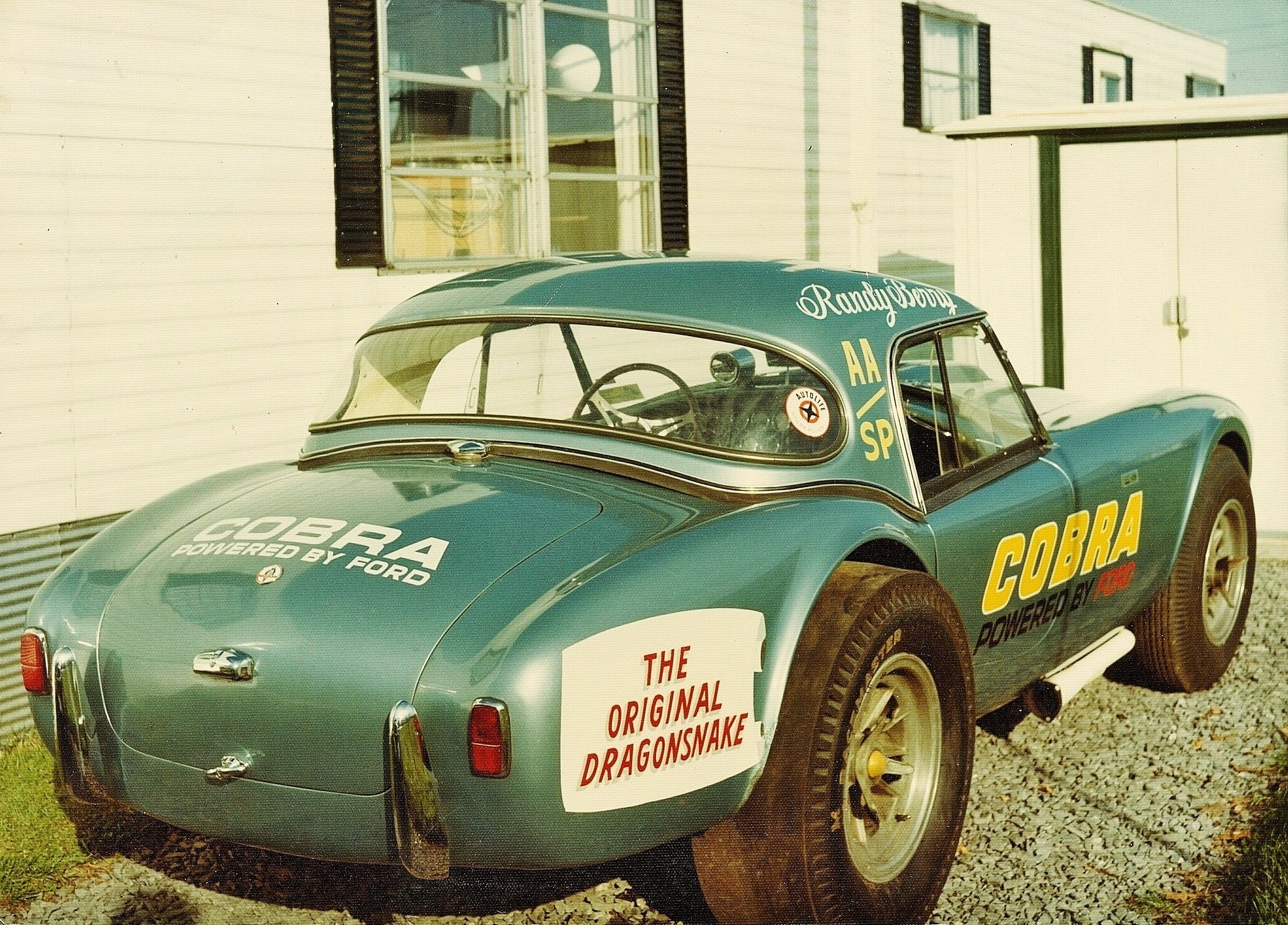
Randy Berry purchased CSX2019 from Shelby and raced it until he sold it in 1967 to Helmut Heindel of Rochester, NY.
The factory Dragonsnake team tended to stay on the west coast—racing primarily in southern California, Nevada and Washington, due to a combination of a limited travel budget and the fact that there were literally hundreds of drag strips across the country—too many for a one-car team to cover during any type of campaign. However, the factory drag car occasionally showed its fangs as far east as Indianapolis and Phoenix City, Alabama. Realizing that they could not be everywhere, the factory team left it to independent drag cars to carry the Cobra banner to drag strips as far east as York, PA and Great Meadows, NJ. The Dragonsnakes, although not as well-known as their FIA or USRRC counterparts, nevertheless played an integral part for Shelby American in Ford’s “Total Performance” campaign. They were driven into the history books, 440 yards at a time.
Until each individual Cobra’s history was thoroughly researched and was shown to add value to each specific cars, it could be said that the Dragonsnakes fell into the category of “forgotten.” But they were by no means “gone.” In fact, all of the factory small-block drag Cobras survive today.
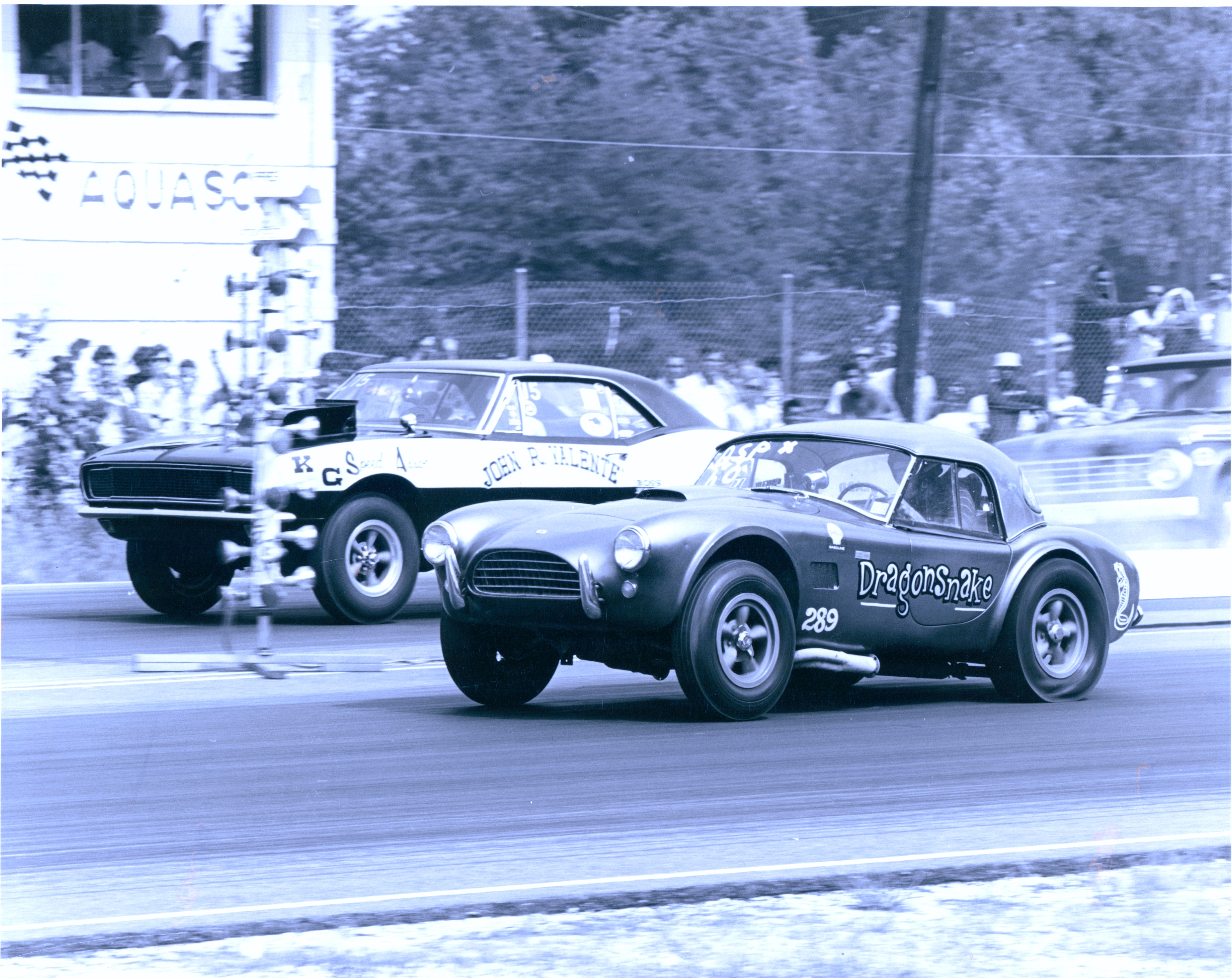
CSX2357 was purchased by Roy Crandall of Homer, NY. He raced it locally, winning most of the races he entered.
CSX2019, the first Dragonsnake, was parked by Shelby American in the spring of 1964 and became a “used car.” It was purchased by Randy Berry (ironically, of Indianapolis—the place of 2019’s drag debut). It was purchased by Helmut Heindel of Rochester, NY in 1967; he still owns the metalflake blue Cobra today.
Factory Dragonsnake #2, CSX2357, has had a tougher time of it. After being retired from competition by the factory, it was purchased by Roy Crandall of Homer, NY and raced very successfully locally. Crandall sold it a couple of years later and it passed on thru several owners until it was purchased by Jay Rodriguez, Bronx, NY. After moving out west, Rodriguez was driving the car on the street when it was disabled by a rock sitting in the middle of the road. He left it to find a pay phone and returned to discover that his Cobra had been rolled down the hill by a motorcycle gang. The wreck was purchased by Hugh Corbett of Chapin, SC. In 1997 it was purchased by Drew Serb of Orinda, CA. Following a lot of research and a thorough restoration to 1964 specifications, the second factory Dragonsnake was displayed at the Petersen Automotive Museum in late 2003/early 2004. At the NorCal Region’s annual Mini-Nats event, held at Sears Point Raceway on Labor Day weekend, 2004, the car was reunited with driver Tony Stoer, who got behind the wheel to “aim” the Dragonsnake down the quarter-mile strip several times as part of a drag race reunion and exhibition.
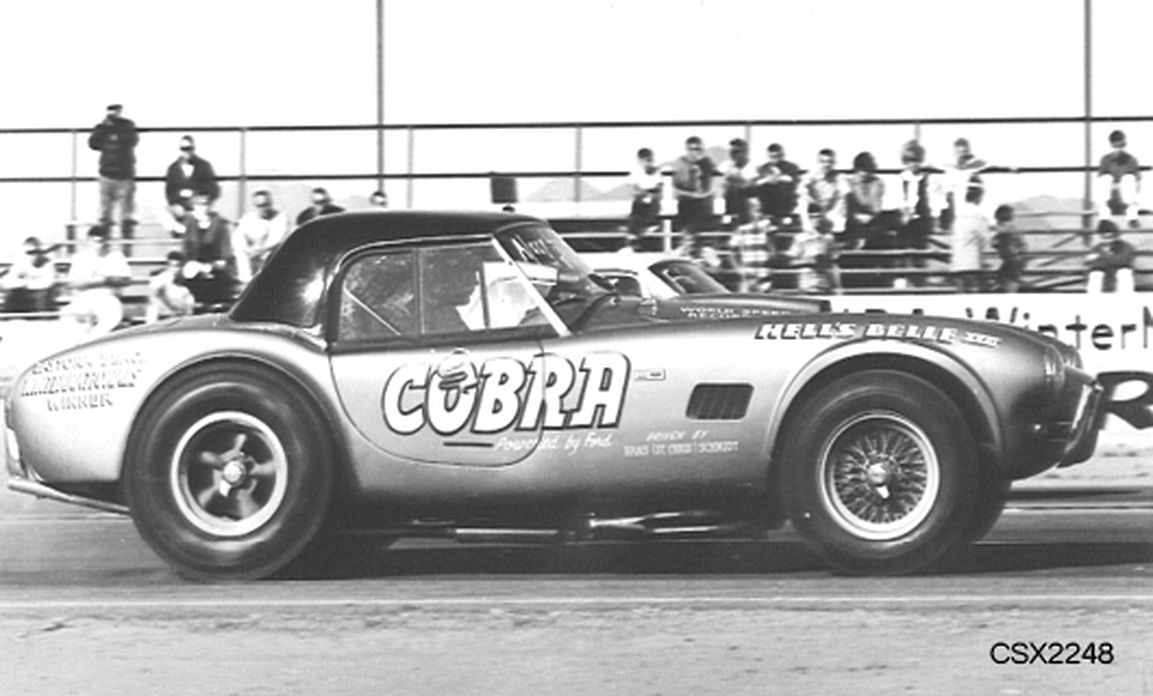
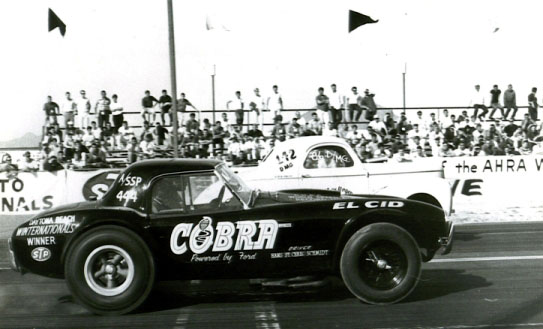
Hans Schmidt of Williamsville, NY was the original owner of CSX2248, “El Cid” and he held on to the car until 1982. It had been severely damaged in a warehouse fire in 1969 and sat outside until it was purchased by Calvin Sanders of Suffolk County, VA. It was purchased by Carroll Shelby who sold it to Lynn Park.
John Reimer, the original owner of Dragonsnake CSX2427, sold the car in 1966. At that time it was still modified for drag racing. This was the only Dragonsnake sold with the Stage 3 (Weber) option. A few more owners, a crash sometime in 1967, and the engine and transmission’s removal led to the car’s restoration in 1995 (using the original engine), and acquisition by Chris Cox of Raleigh, NC in 1996. Today it sports the original Thunderbird Yellow color it was originally painted—to match Reimer’s Thunderbird tow car. Richard Mason of Carson City, NV sold the car to Steve Juliano who put the car on display at his private museum in San Clemente, CA.
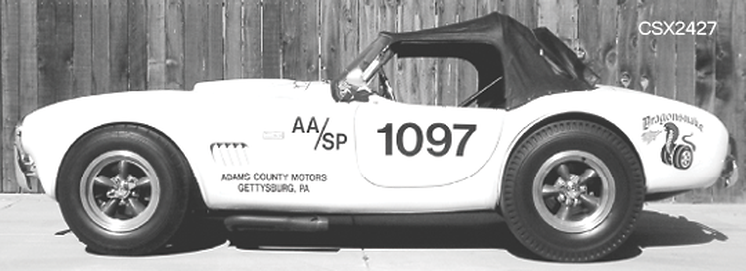
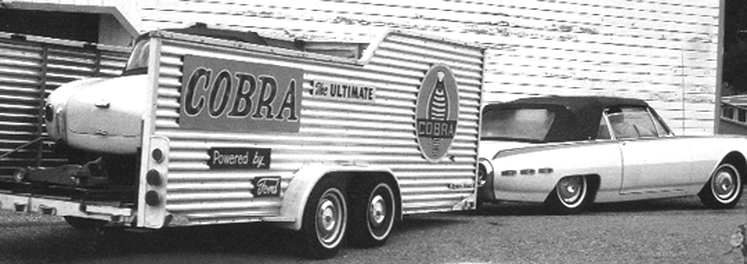
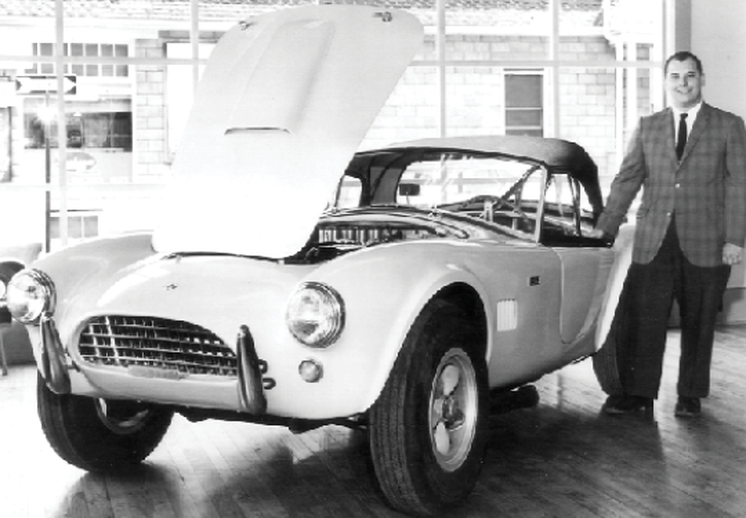
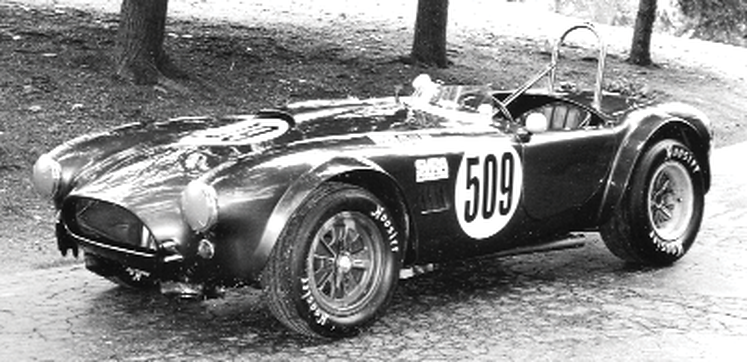
CSX2472 is owned by J.J. Rodman of Glenshaw, PA. The ex-Dragonsnake is presently outfitted for road racing and sees its share of vintage action.
Ed Hugas, of one of the original Cobra dealers in Pittsburgh, was the first owner of Dragonsnake CSX2472. Converted into a drag car by Shelby American in mid-build, a large number of problems resulted in Hugas repainting the car upon delivery. It was sold to Russ Freed in Pittsburgh, who used the drag Cobra as a street car. Three more owner changes followed, with two being by the same individual, J.J. Rodman of Glenshaw, PA. Rodman sold the car and then in a pique of remorse, purchased it back. It still carries many of its original race features but Rodman has also added a few road racing modifications and has been vintage racing it over the past twelve years, mostly at tracks in the northeast such as Pocono, Summit Point and Watkins Glen.
A few street Cobras were converted for drag racing by their owners. Probably the most famous was CSX2093. Purchased from a used car lot in Pennsylvania by Jim Costilow in 1964, he initially competed in road races and hill climbs but decided to go drag racing. He brought the car to Bruce Larson, a drag racer working at a local Chevy dealership. Larson modified the car and began driving it, painted purple metalflake, eventually winning several national titles, including the WinterNationals at Pomona. Additionally, he set a few national records along the way. The car was sold in 1966 to Ed Hedrick, who kept it the same color and raced it very successfully, winning several national titles including the NHRA’s World Championship. Following that, it went through a chain of owners, dealers and auctions for 23 years before being restored to its original, as-raced condition—including fuchsia metallic paint. It was shown at SAAC-18 at Watkins Glen and received a Gold Award in the concours. It was eventually purchased by its original driver, Bruce Larson of Stony Creek, PA. It was sold at the Mecum Auction is Kissimme, FL in January, 2007 to Don Wallace (Tampa, FL).
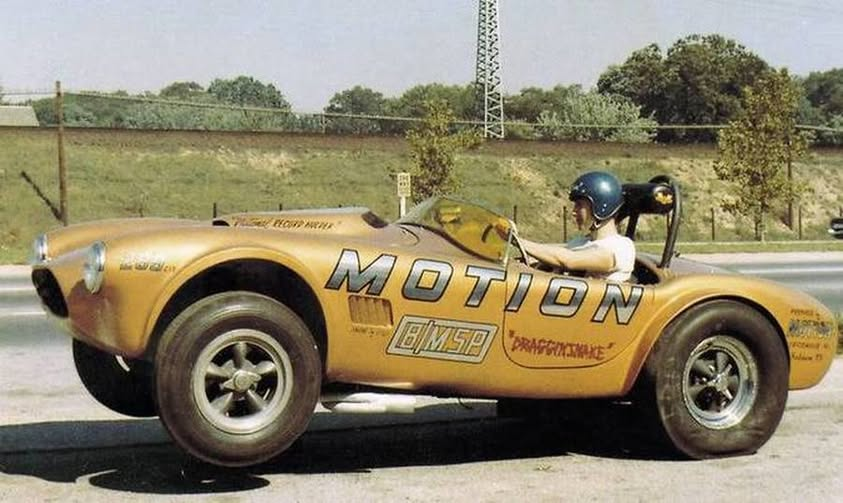
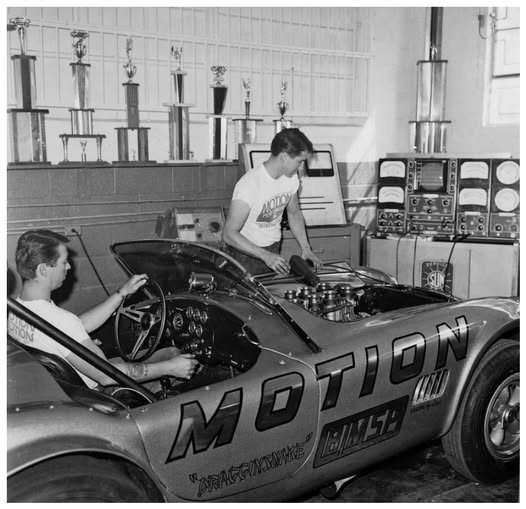
Another small block Cobra was prepared and raced by Motion Performance, a high visibility performance shop on Long Island that specialized in building drag cars. Motion was always able to get their cars into magazines and their Cobra (serial number unknown) was no exception. It ran in several different classes at various times, including being match-raced with a fuel injected engine. It set a 1/8-mile record for its class.
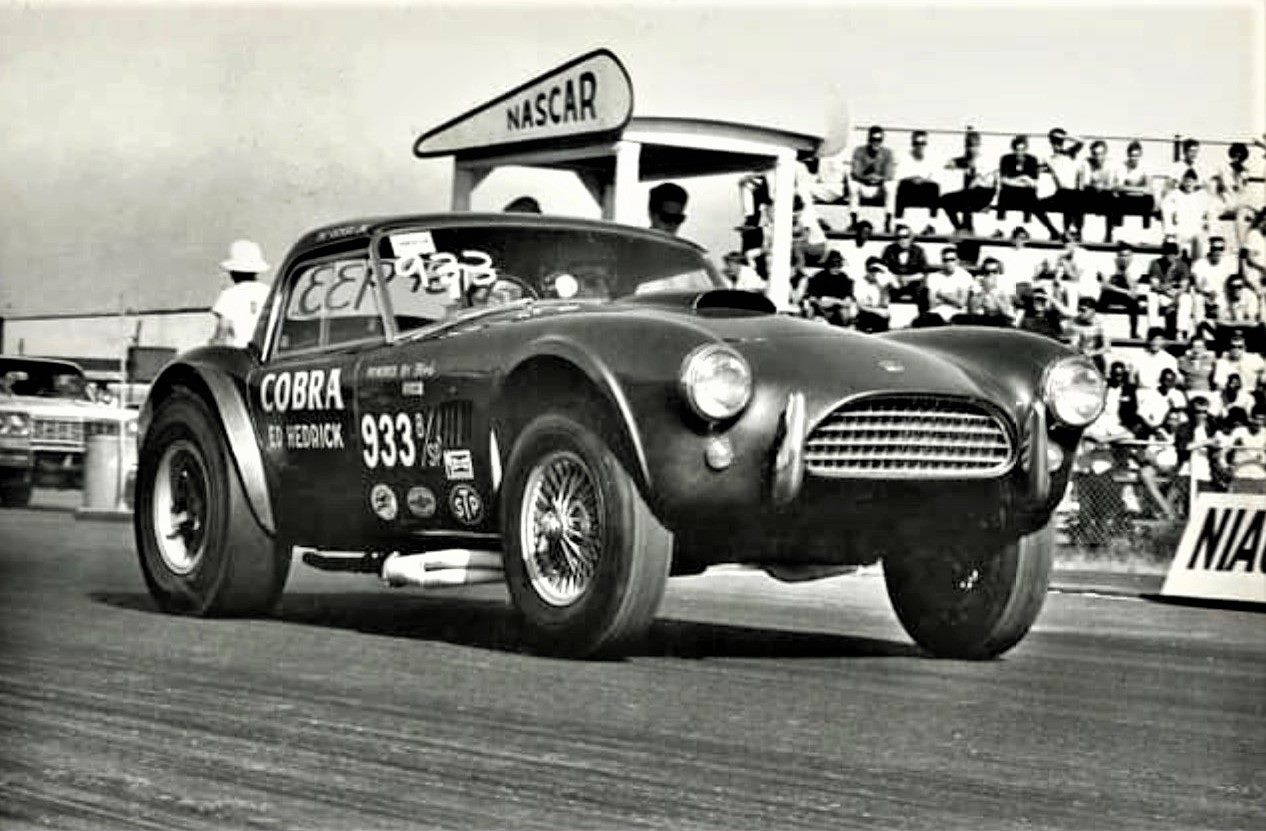
CSX2093 was originally owned by Jim Costilow and driven by Bruce Larson. Costilow sold the car to Ed Hedrick who continued to successfully race it.
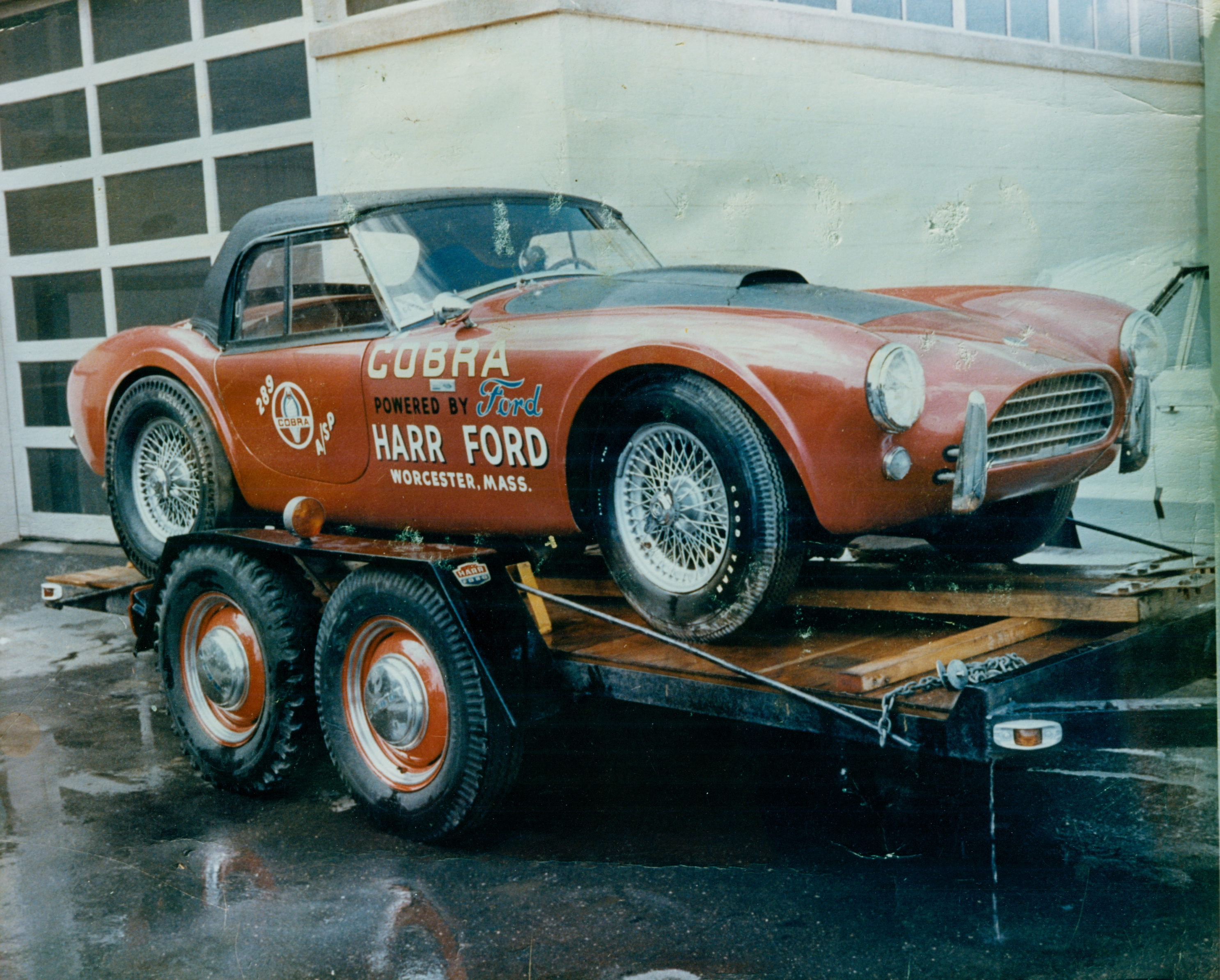
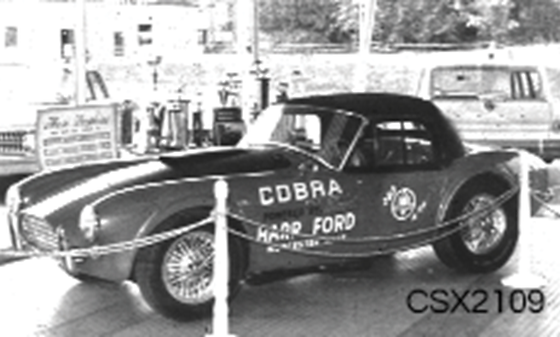
CSX2109 started out as E. Providence, RI mega-Ford dealer Bob Tasca’s personal car for most of 1963. It was purchased by Larry MacAllister, who had Harr Ford service manager Gus Zuidema modify it to drag race. Zuidema raced it throughout 1964, racking up twenty class wins. That was enough to get him to the Nationals at Indianapolis. Zuidema was concerned about the legality of the ‘64 Hi-Po heads on a ‘63 car, so on the final round he intentionally hesitated coming off the line. His competitor, Ed Terry in the factory Dragonsnake CSX2357, reached the finish first, even though Zuidema had a lower ET and a faster top speed. Adding insult to injury, he later learned that the heads were legal. Zuidema would later go on to successfully campaign the only factory-built 427 Dragonsnake, CSX3198.
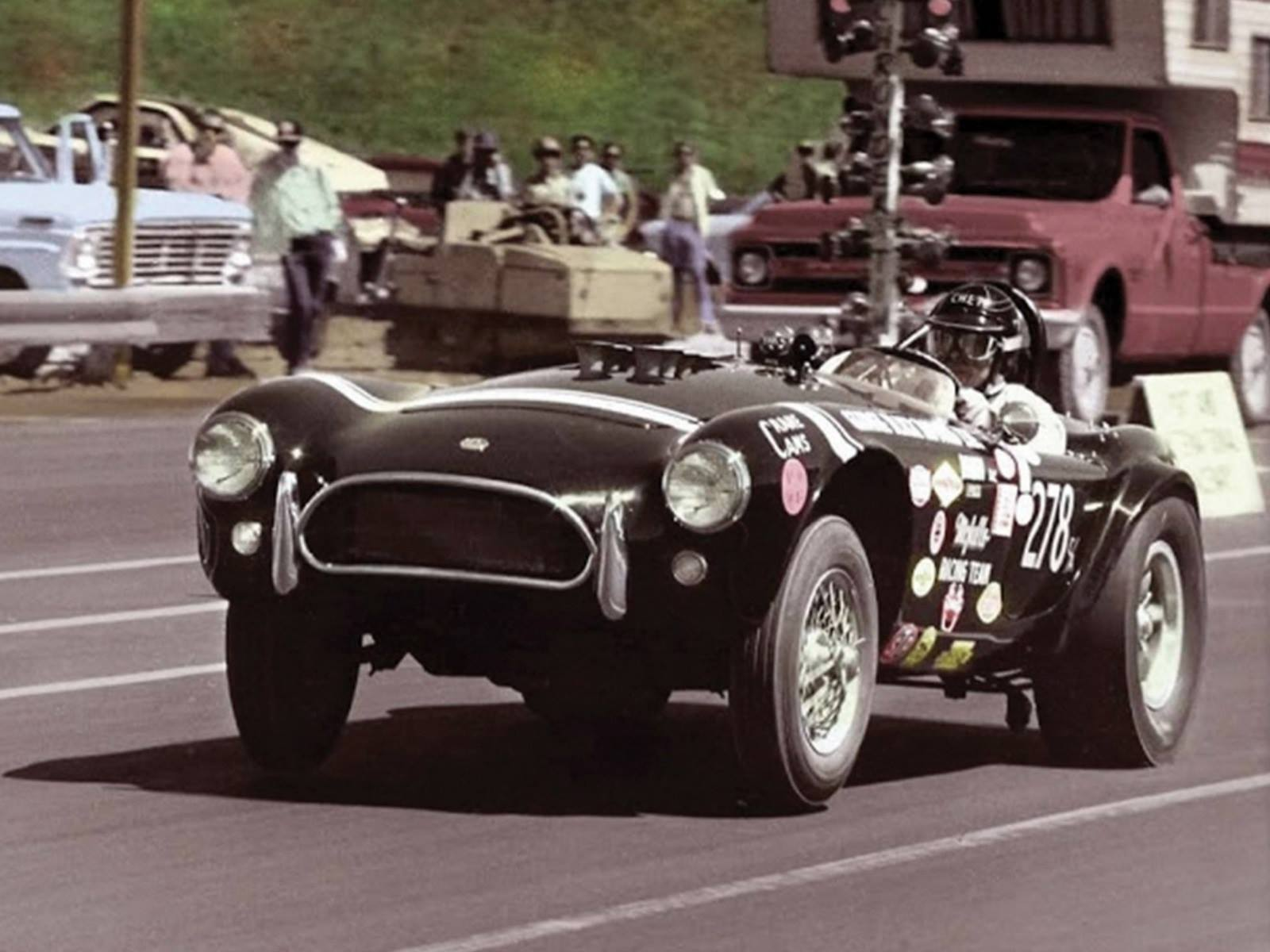
CSX2075 was originally a street car, purchased by Chet McFallo of Portland, OR. He upgraded it to drag race specs and initially ran in B/Sports with a 4V carb. In a quest for “faster” he modified it to run in C/Altered by installing a Gurney-Eagle engine with Hilborn fuel injection, devised a strut rod set-up for the front suspension and added wheelie bars. His best quarter-mile time was 10.43 sec @ 138 mph.
Zuidema would later go on to successfully campaign the only factory-built 427 Dragonsnake, CSX3198.