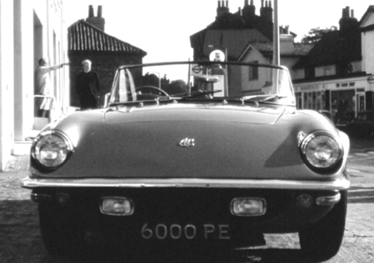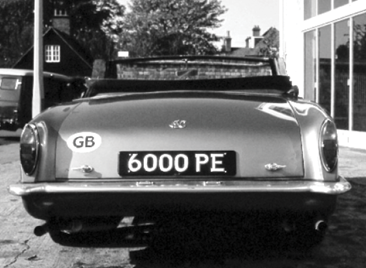
At the very beginning of the Cobra program, AC Cars, Ltd. had no idea how long it would last or to what extent its facilities would be taken up by Cobra production. Shelby American’s initial contract was for 50 cars, and although this consumed a lot of AC’s resources, it was not all they did. Looking to their future, in 1962, as Cobra production was beginning to ramp up they began work on a prototype two-seat, open sports car which they felt could replace the AC Ace, no longer in production.
The original AC Ace, and the small block Cobra that came after it, were both based on a chassis designed by John Tojeiro in the 1950s. It consisted of a pair of large parallel main tubes separated by perpendicular cross-tubes much like the rungs of a ladder. Transverse leaf springs were mounted at each end; the spindles were attached to the frame by unequal-length A-arms with their travel controlled by the end of the leaf spring. It was a dated design for a new car. AC’s in-house designer, Z.T. Marzewski conceived a square-tube space frame fitted with inboard rear disc brakes, a high-mounted rack-and-pinion steering assembly and coil-over shock absorbers. It was slightly larger than the Cobra in almost every dimension: wheelbase was six inches longer than the 90˝ Cobra; at 54˝ the track was 3˝ wider; overall length was 172˝ (the Cobra’s was 151.5˝); and with a width of 67˝ it was six inches wider than a Cobra. A five-speed transmission was designed for the car and this, along with several other engineering innovations, were envisioned as carrying this car through the 1960s and even into the 1970s.
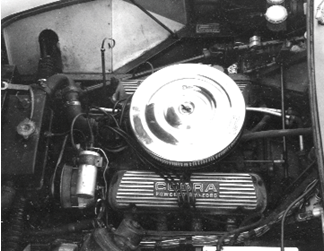
The MA-200 was originally designed for a 6-cylinder engine but Marzewski was asked to modify it to accept a Ford 289 V8 for reasons of cost savings. A 289 race engine had been presented to AC Chairman Derek Hurlock by the Ford Motor Company in recognition of the company’s assistance in it’s first foray at LeMans. Two specially prepared Cobras with fastback-style hard tops had been entered in the 1963 24-hour event, one under the AC Cars banner and the other by early Cobra dealer Ed Hugus of Pittsburgh. The thinking was that Ford and Shelby did not want to take the chance of being on the receiving end of unfavorable publicity if the Cobras failed to finish. The Hugus entry retired at the halfway point, sidelined by a broken connecting rod. The AC car finished 3rd in the GT class and 7th overall. It was an excellent showing and Ford rewarded Hurlock by giving him the left-over spare race engine, one of only 5 built for the event.
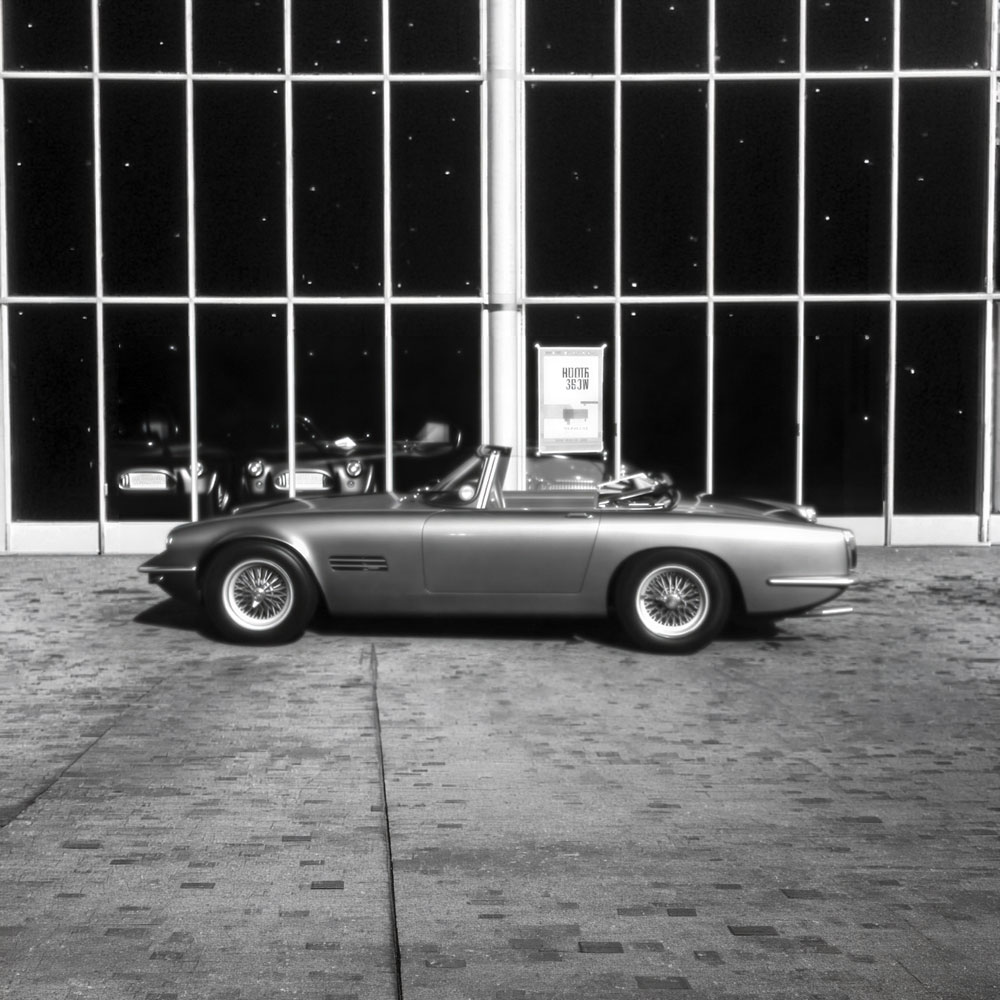
The body was made from aluminum and the shape was slab-sided and rectangular. It was unlike anything else of that period but in the 1960s and 1970s was actually quite contemporary. AC records show that on November 19, 1963 the completed car was registered for road use. Rather than receive a serial number which fit into the AC numbering system, it was assigned the number “MA-200.”

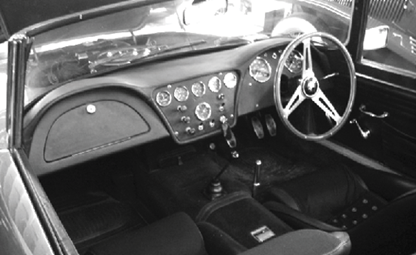
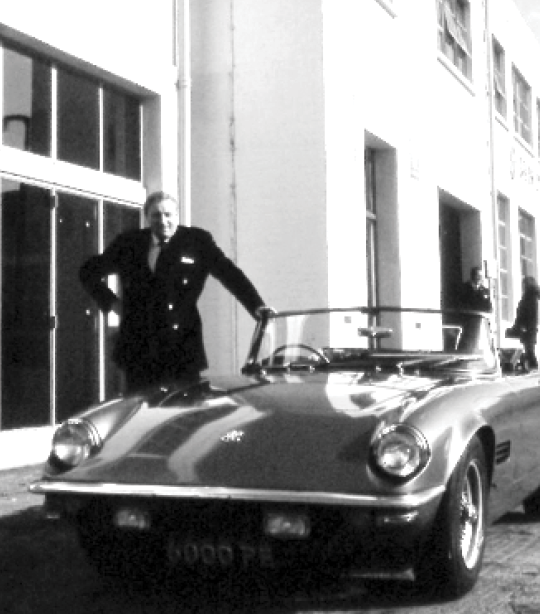
MA-200 is parked in front of AC Cars’ showroom. Note new Cobras parked inside.. The Cobra engine was not the only part taken off the shelf for this car; it also had Cobra 72-spoke wire wheels and a Cobra 3-spoked wood steering wheel.
MA-200 was used by Derek Hurlock as his personal transportation during its development stage as well as over the next few years. He seemed to prefer it over a Cobra roadster, most likely because it represented a vehicle that was purely an AC design. Although the Cobra was based on the AC Ace, by the time production had begun it shared very few pieces with its British cousin. Throughout Cobra production, no one at AC Cars believed they were building a car that was truly “their own.” They were merely supplying a vehicle built to someone else’s specifications.
MA-200 was never put into production and only the one prototype was ever built. Hurlock continue driving it until 1968, when it was sold. It had been thought that it served as the inspiration for the AC 428 Frua models but that is not likely because their design is the product of Italian coachbuilders. The resemblance is more along the lines of a coincidence.
The car was sold by AC Cars to Roger Field in 1968, It was put in storage for many years and then, in 1983, it was purchased by Peter Hague. MA-200 was maintained in original condition and only recently received new paint and a rebuild of the original engine. In 2006 the car was purchased by SAAC member Mark Gold of Miami, FL.